
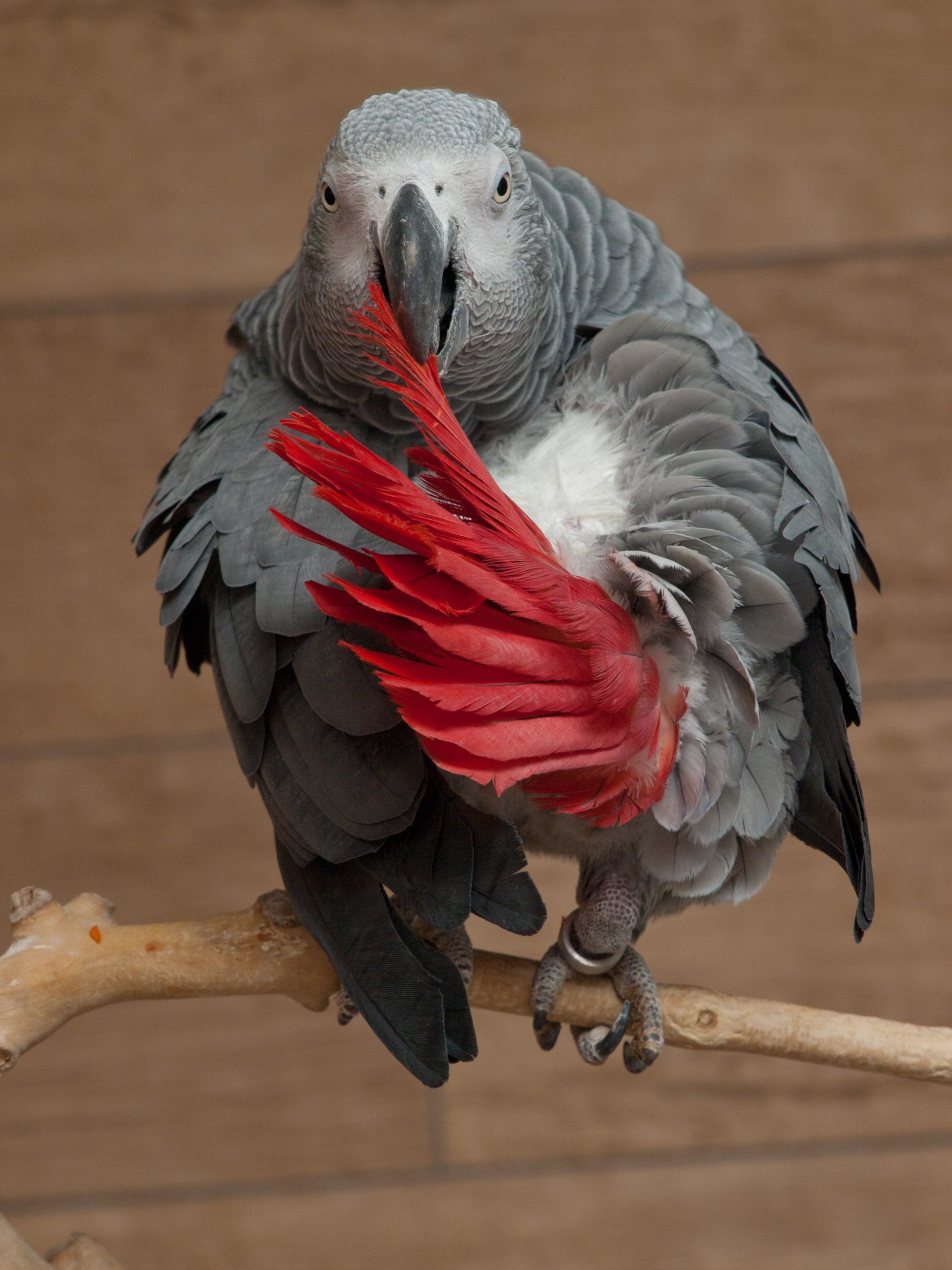
The African Grey Parrot is one of the most famous birds in the world, and for good reason. It’s a medium-sized parrot, roughly 13 inches long, that gets an outsized reputation from its brainpower rather than flashy colors. Their body is covered in soft, scalloped grey feathers, with darker grey on the head and wings and lighter shading toward the belly, and a bright red tail that pops against all that grey.
There are two recognized forms: the Congo African Grey, which is larger with a black beak and vivid red tail, and the Timneh, a smaller bird with darker feathers, a horn-colored upper beak, and a maroon tail. Both share the same sharp mind and social spark that makes the species so beloved.
What really sets this bird apart is its intelligence. Researchers have found their cognitive abilities comparable to a young child, and they’re considered among the best talkers in the bird world, often using words in a way that suggests real understanding rather than simple mimicry.
African Greys come from the equatorial rainforests of West and Central Africa, ranging across a broad swath of the continent from Ivory Coast through Nigeria, Cameroon, and the Democratic Republic of Congo into Uganda, Kenya, and Tanzania. In the wild they favor dense, humid lowland forest, forest edges, mangroves, and wooded savannah, often roosting in tall trees near rivers or on offshore islands.
People have kept these parrots as companions for an extraordinarily long time. There are references to them being kept in households as far back as ancient Egypt, and their popularity as pets has only grown over the centuries thanks to that remarkable talking ability.
In more recent history, the species became a scientific celebrity through the work of researcher Irene Pepperberg and her parrot Alex, whose three-decade partnership showed the world that a bird could grasp shapes, colors, numbers, and even the concept of zero. Alex’s abilities, and Pepperberg’s follow-up work with other Greys, permanently changed how scientists think about animal minds.
Unfortunately, that same fame has taken a toll on the species in the wild. Heavy trapping for the pet trade combined with habitat loss has pushed the African Grey to Endangered status, and it now has the strictest international trade protections available under CITES.
African Greys are deeply social birds that thrive on connection, whether with their own flock in the wild or with the people in their lives as pets. They tend to bond tightly with one or two favorite humans and are often remarkably tuned in to their handler’s moods and routines.
That sensitivity is a double-edged sword. These birds need consistent mental stimulation, puzzle toys, and daily interaction, and when they’re bored or under-stimulated they can develop stress behaviors like feather plucking. A stable routine and an enriched environment go a long way toward keeping a Grey happy.
Their talking ability is central to their personality. Many Greys learn to use words and phrases in context, asking for food, greeting people, or expressing feelings, which makes them feel almost like conversational partners rather than just pets. In the wild this same vocal drive shows up as constant chatter and calling within flocks, since staying in touch with the group matters for their survival.
Because they’re so smart and so bonded to their people, African Greys aren’t a low-maintenance choice. They do best with owners who have the time, patience, and long-term commitment to match their emotional and intellectual needs.
Did you notice something that could be improved? Something wrong, or something you'd like to share, comment on, add, or remove? We'd really appreciate your help. Got general feedback or a complaint instead of a specific edit? Use our Contact Us page.
Log in to suggest an editSources: Beardsley Zoo - https://www.beardsleyzoo.org/african-grey-parrot.html · Britannica - https://www.britannica.com/animal/African-gray-parrot · National Geographic - https://www.nationalgeographic.com/animals/birds/facts/african-gray-parrot · LafeberVet - https://lafeber.com/vet/basic-information-sheet-for-the-african-grey-parrot/ · Maryland Zoo - https://www.marylandzoo.org/animal/african-grey-parrot/ · IFAW - https://www.ifaw.org/animals/grey-parrots · World Parrot Trust - https://parrots.org/projects/grey-parrots-confiscation-and-rehabilitation/ · Wikipedia (Grey parrot) - https://en.wikipedia.org/wiki/Grey_parrot · Audubon - https://www.audubon.org/news/how-irene-pepperberg-revolutionized-our-understanding-bird-intelligence · Falls Road Animal Hospital - https://www.fallsroad.com/site/tips-resources-blog-baltimore-vet/2021/12/23/african-grey-parrot-good-pet · Cornell Lab Bird Academy - https://academy.allaboutbirds.org/african-grey-parrot-species-in-decline/