
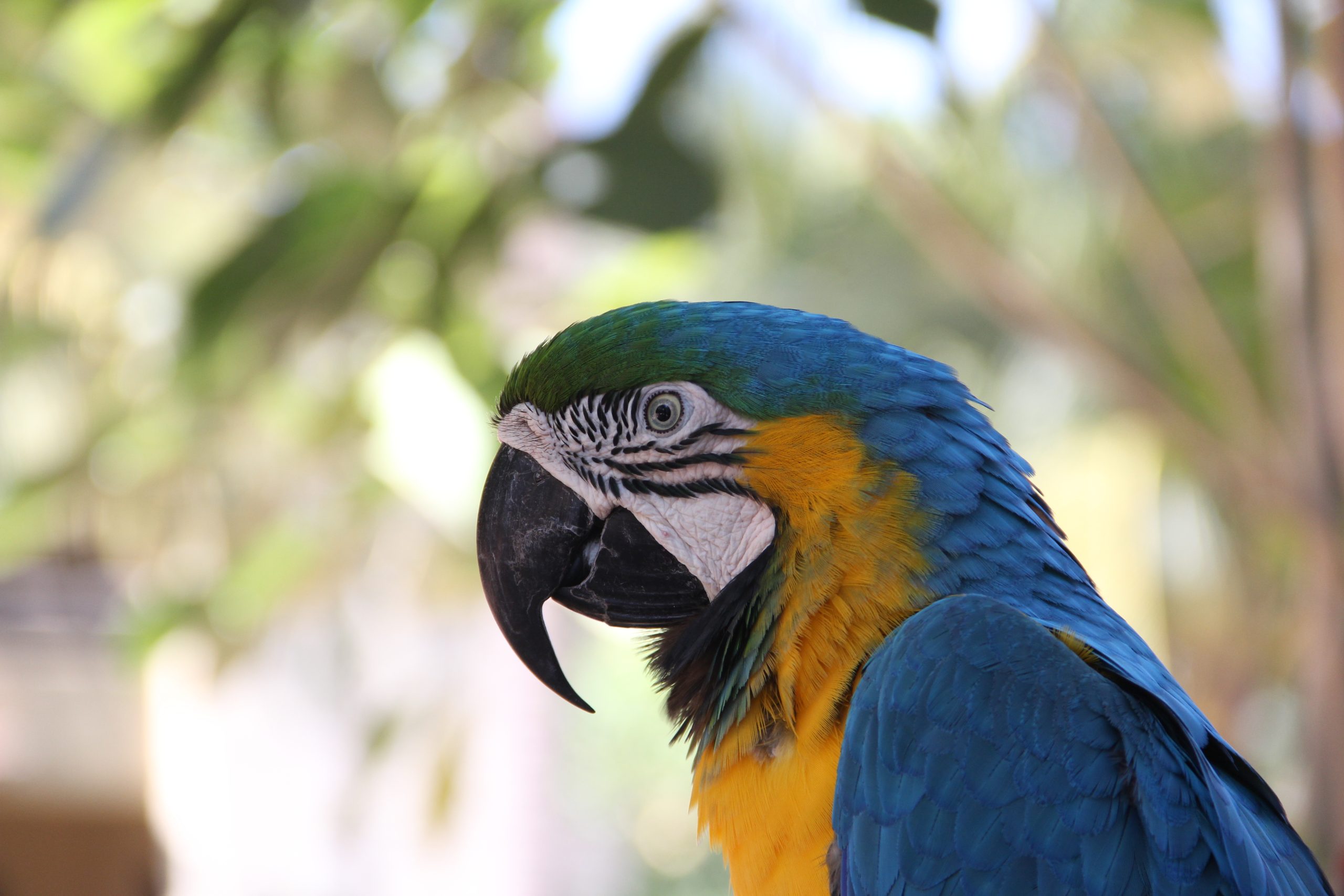
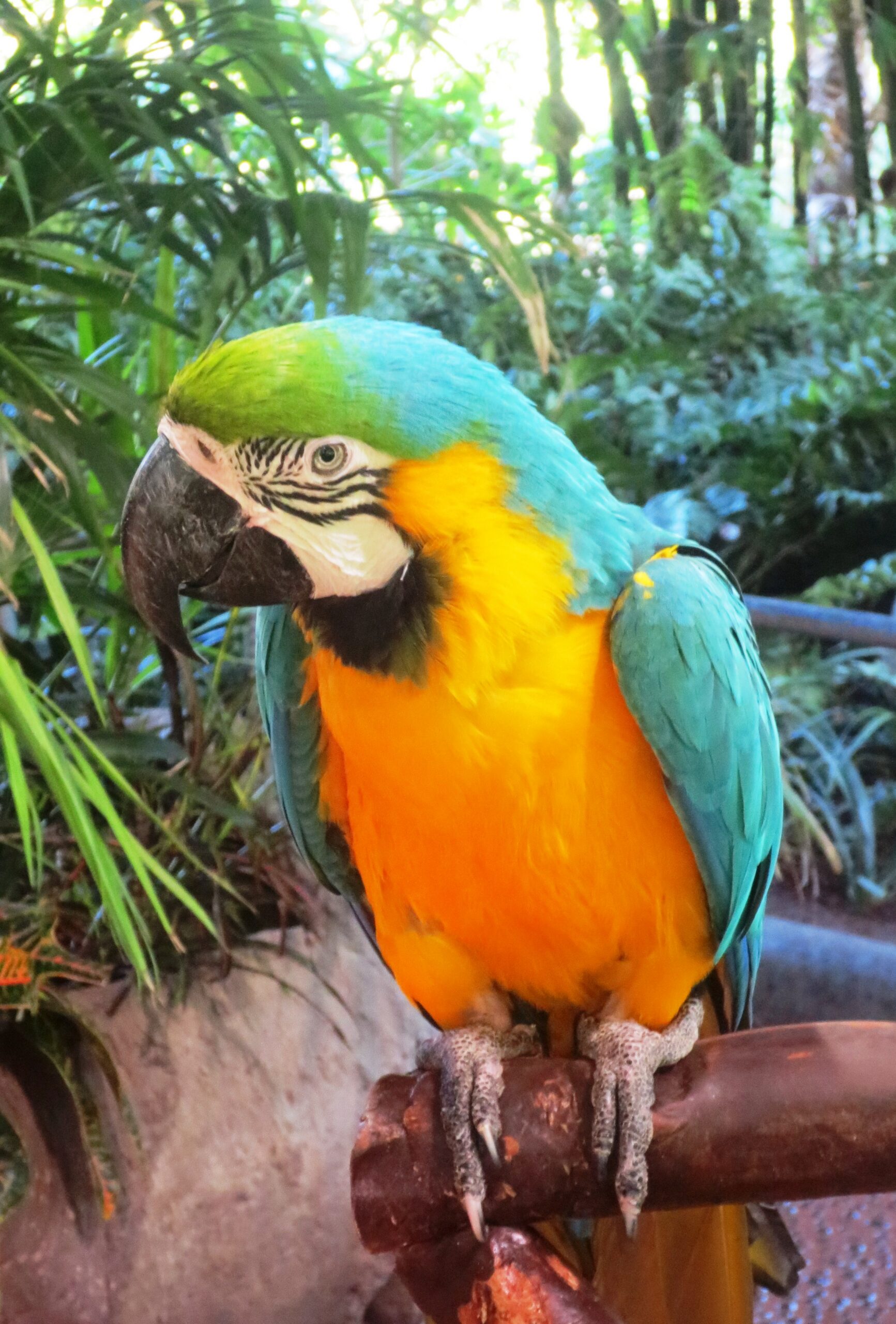
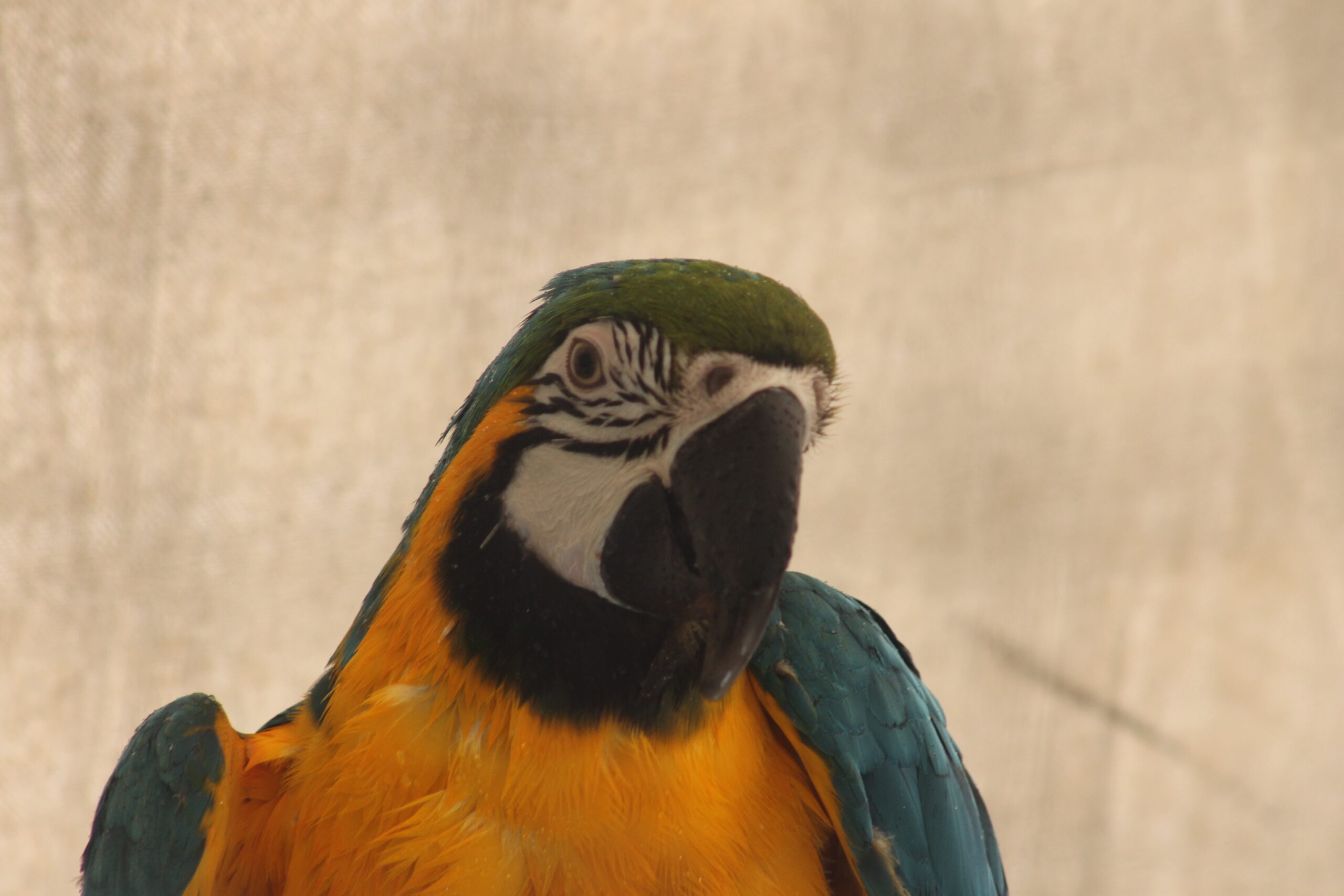
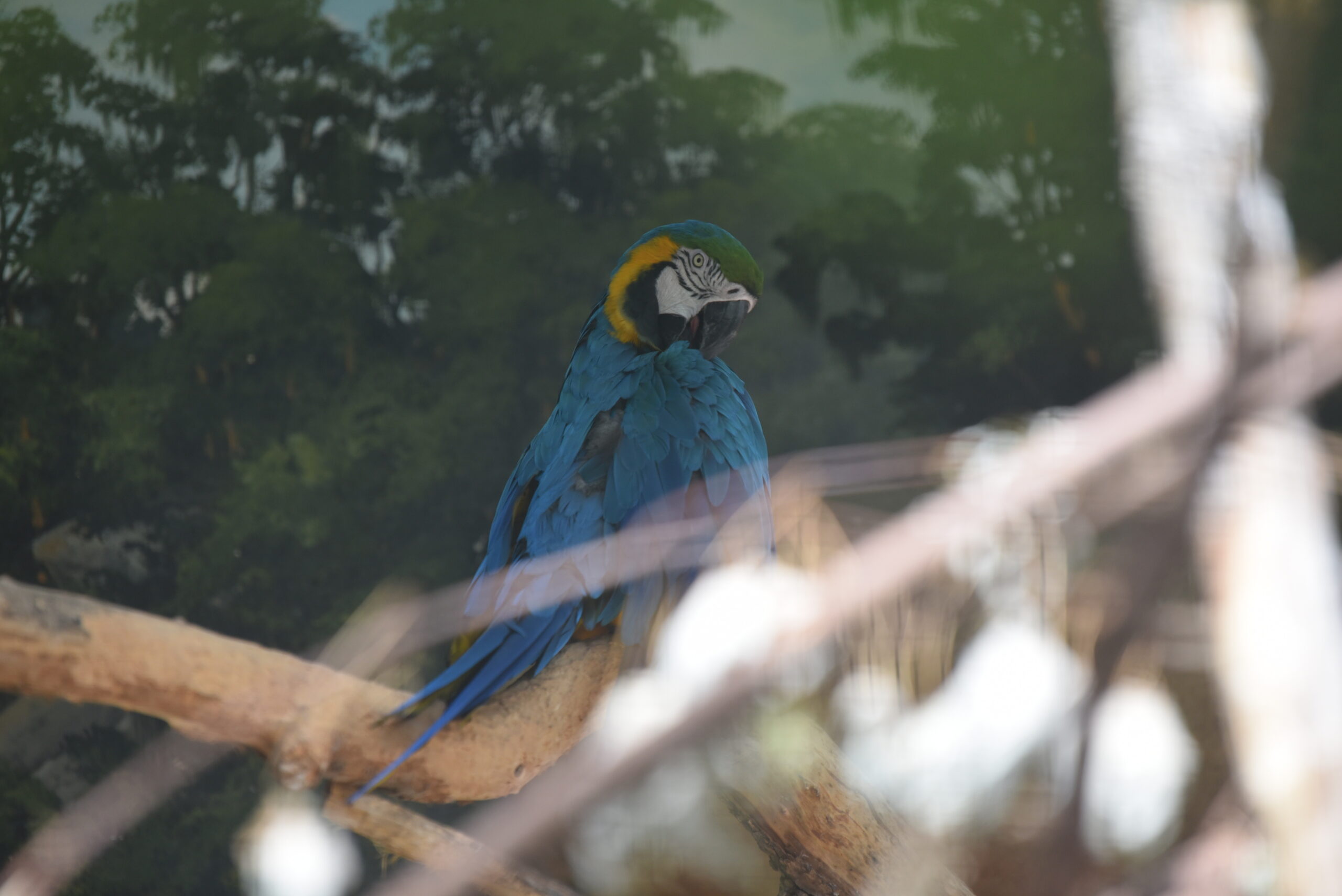
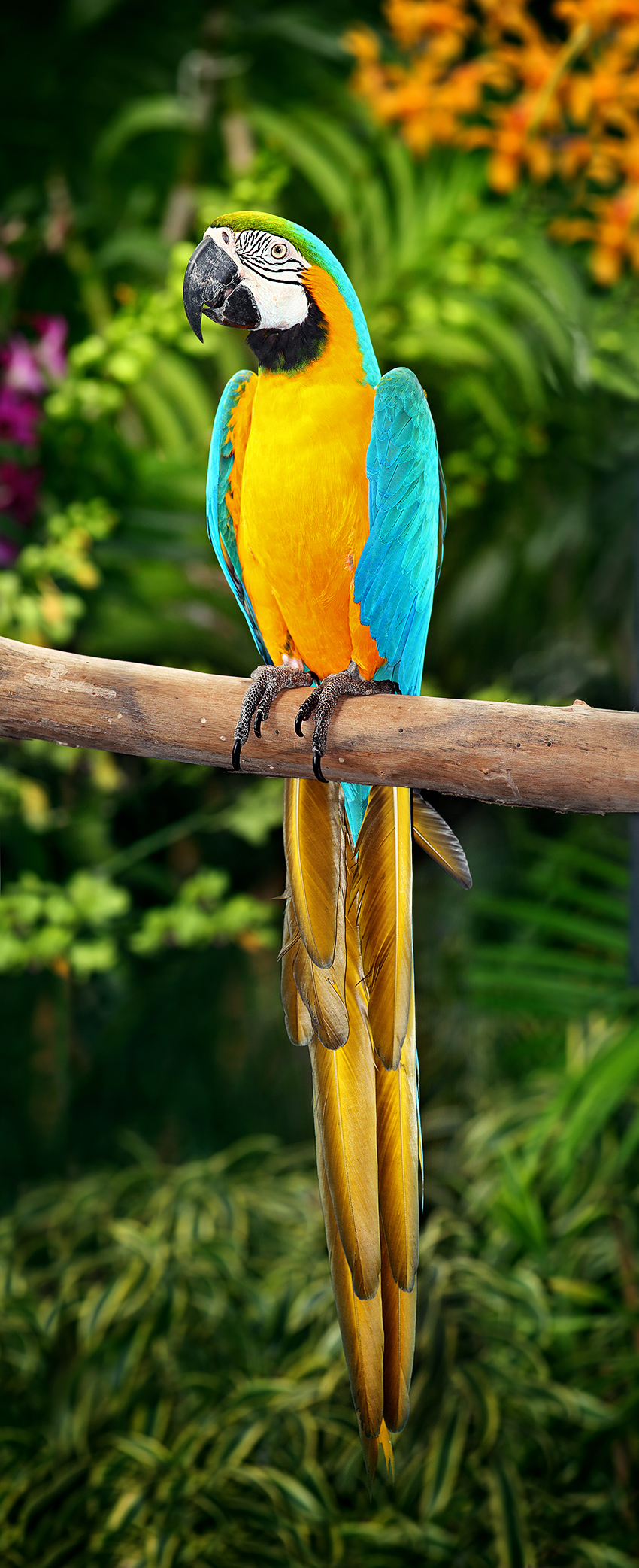
The Blue-and-Yellow Macaw, also called the Blue-and-Gold Macaw, is one of the most recognizable parrots on the planet, and it’s easy to see why. Its scientific name is Ara ararauna, and this bird is a true showstopper with a mostly blue back, wings and tail paired with a warm golden-yellow belly and chest, plus a patch of lime green right on top of its head. It’s also one of the larger macaws out there, so this isn’t a small bird by any measure.
Adult birds typically measure 32-36 inches (81-91 cm) in length, with a wingspan of 41-45 inches (104-114 cm). They tip the scales anywhere from 31.7-64 oz (900-1814 g). Beyond the stunning colors, one of their most distinctive features is white skin on the face, which is nearly featherless besides a few black feathers spaced apart, forming a striped pattern around the eyes.
These birds aren’t just pretty faces, either. They’re popular as pets because they’re beautiful, behaviorally complex, and have the ability to mimic words and sounds. They’re intelligent, social animals who become close to their owners when handled well. That said, their size and needs mean they’re a serious, long-term commitment rather than a casual pet.
The Blue-and-Yellow Macaw calls the forests, woodlands and savannas of Central and South America home. This macaw hails from South and Central America, from Panama to Brazil, Paraguay, Bolivia, and Venezuela south to Peru. They tend to favor life near water, and they nest strictly in palm trees in the wild, often high up to keep their eggs and chicks safe from predators.
Their name actually has deep roots in South American culture. The genus name is from ará meaning “macaw” in the Tupi language of Brazil, an onomatopoeia based on the sound of their call. Macaws in general have shared a long history with people; Indigenous cultures throughout Central and South America revered these birds, valuing their brilliant feathers for ceremonial dress, symbolic art, and trade, and archaeological evidence shows that macaws were kept in captivity by ancient civilisations such as the Mayans and Aztecs.
Sadly, that long relationship with humans has had a dark side too. The illegal pet trade removed enormous numbers of Blue and Gold Macaws from wild populations during the 1970s and 1980s, with tens of thousands exported annually before international trade restrictions were implemented. Today the species is listed as Least Concern by the IUCN thanks to its wide range, though the population trend is declining, though not enough yet to reach vulnerable status, with populations considered greater than 10,000 adult macaws. Small feral populations have even popped up outside their native range, including a breeding population descended from introduced birds found in Puerto Rico, and another that has inhabited Miami-Dade County, Florida, since the mid-1980s.
If there’s one word to describe a Blue-and-Yellow Macaw’s personality, it’s big. They are as inquisitive as a kitten and playful as a puppy. These birds bond deeply with their families and often become a bit of a “one person” bird, forming an especially tight connection with a favorite human while still being affectionate with the rest of the household.
In the wild, they’re rarely loners. These parrots tend to stay in pairs or small family groups quite high in the trees, but early in the morning and in the late afternoon, they join up with large and noisy flocks while feeding. Bonded pairs are especially sweet to watch, since when they fly in pairs they are known to fly very close to each other so that their wings touch.
That said, life with a macaw isn’t all cuddles and quiet moments. Macaws are social creatures and need plenty of time outside their cages each day, and they’re prone to ear-shattering vocalizations and contact calls, which are often unappreciated by close neighbors. They’re also notorious chewers, so they love to chew paper and wood items, such as furniture and books, which means owners need to supervise them closely and keep plenty of safe toys on hand. Given how smart these birds are, though, that same energy makes them fantastic candidates for trick training and mental enrichment games.
Did you notice something that could be improved? Something wrong, or something you'd like to share, comment on, add, or remove? We'd really appreciate your help. Got general feedback or a complaint instead of a specific edit? Use our Contact Us page.
Log in to suggest an editSources: EDDMapS - https://www.eddmaps.org/species/subject.cfm?sub=13149 · Birda Species Guide - https://app.birda.org/species-guide/13393/Blue-and-yellow_Macaw · Detroit Zoo - https://detroitzoo.org/animal/blue-and-yellow-macaw/ · AnAge / Genomics.senescence.info - https://genomics.senescence.info/species/entry.php?species=Ara_ararauna · Animal Diversity Web - https://animaldiversity.org/accounts/Ara_ararauna/ · Cincinnati Zoo - https://cincinnatizoo.org/animals-archive/blue-and-yellow-macaw/ · Wikipedia - Blue-and-yellow macaw - https://en.wikipedia.org/wiki/Blue-and-yellow_macaw · Lafeber Co. - https://lafeber.com/pet-birds/species/blue-and-gold-macaw/ · Wide Open Spaces - https://www.wideopenspaces.com/blue-and-gold-macaw-bird/ · Susan Clubb Bird Species Profiles - https://susanclubb.com/knowledge-center/bird-species-profiles/18-macaws/60-blue-and-gold-macaw · The Vet Desk - https://thevetdesk.com/pet-breeds/birds/blue-and-gold-macaw/ · Parrot Secrets - https://parrotsecrets.com/Blue-Gold-Macaw/about-blue-gold-macaw.php · iNaturalist - https://www.inaturalist.org/taxa/19018-Ara-ararauna · Peru Aves - https://www.peruaves.org/psittacidae/blue-and-yellow-macaw-ara-ararauna/ · Parrot Essentials - https://parrotessentials.co.uk/blog/macaws-as-pets-what-its-really-like-to-own-one · Furry Critter Network - https://www.furrycritter.com/pages/descriptions/birds/blue_and_gold_macaw.htm · Happy Hollow Park & Zoo - https://happyhollow.org/explore/zoo/zoo-in-the-hollow/blue-and-gold-macaw/ · Elmwood Park Zoo - https://elmwoodparkzoo.org/animal/blue-and-gold-macaw/ · Photo: Bjoertvedt - https://commons.wikimedia.org/wiki/File:Ara_ararauna_LoroParqueTenerife_blue_and_yellow_macaw_IMG_6856.JPG (CC BY-SA 4.0) · Photo: Noah Wulf - https://commons.wikimedia.org/wiki/File:Blue-and-Yellow_Macaw-Age_of_Chivarly.jpg (CC BY-SA 4.0) · Photo: R. J. Mathar - https://commons.wikimedia.org/wiki/File:Blue-and-yellow_macaw_Zoo_Karlsruhe_2025-09-01T15-01-12.jpg (CC BY 4.0) · Photo: Benjamint444 - https://commons.wikimedia.org/wiki/File:Blue-and-Yellow-Macaw.jpg (GFDL 1.2)