
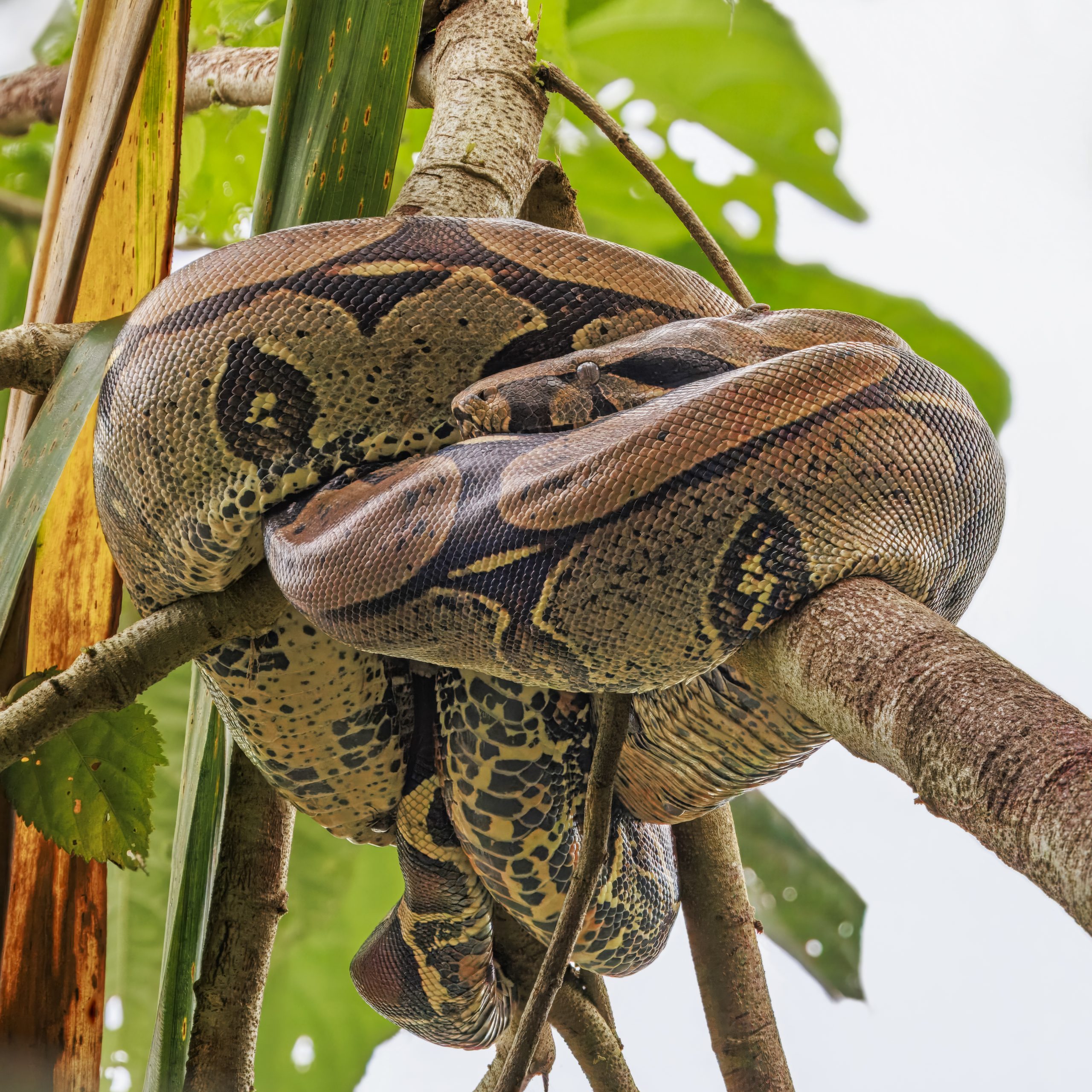
The boa constrictor is one of the most recognizable snakes in the world – a big, heavy-bodied constrictor with a calm reputation and gorgeous camouflage patterning. Depending on subspecies, adults typically run about 6 to 10 feet long, though some individuals grow much larger, and they carry a lot of muscle packed into that thick body. Their coloring is a big part of the appeal: tan, brown, gray or cream base tones dressed up with darker saddle-shaped blotches that often deepen into rich reddish tones toward the tail.
This is a snake built for ambush, not speed. It has a broad, triangular head, small hooked teeth for gripping prey, and heat-sensing pits near the mouth that let it detect warm-blooded animals even in total darkness. Despite the fearsome constricting reputation, boas are non-venomous, and wild adults pose no realistic threat to people.
Boa constrictors are a New World species, native only to the Americas, with a range stretching from northern Mexico down through Central America and much of South America as far south as northern Argentina. They also turn up on a number of islands off the Pacific coast and in the Caribbean, including the Lesser Antilles, Trinidad and Tobago, Dominica, and St. Lucia. Across that huge range they’ve settled into all kinds of habitats, from steamy rainforest edges to dry scrubland, savanna, and semi-desert.
Because the species spans so many countries and climates, taxonomists have split it into a number of regional subspecies and closely related species, with disagreement over exactly how many are valid. Farmers in parts of its range have traditionally welcomed boas around fields and storage sheds simply because they’re so effective at controlling rodent populations. The snake’s calm nature and striking looks eventually made it one of the most popular large snakes in the exotic pet trade worldwide, particularly forms like the red-tailed boa.
In the wild, boa constrictors are solitary, mostly nocturnal hunters that spend the day tucked away in hollow logs, abandoned burrows, or tree hollows, then come out from dusk to dawn to hunt. They’re patient ambush predators at heart, lying in wait for birds, rodents, and other mammals before striking, though researchers have also documented individuals actively foraging during the day, showing they’re more flexible hunters than once thought. Once prey is caught, the boa wraps it in coils and squeezes until it can no longer breathe, then swallows it whole.
Young boas climb quite a bit and are considered semi-arboreal, but as they grow larger and heavier they become mostly ground-dwelling. They’re also strong swimmers when needed, even though they prefer to stay on dry land most of the time.
As pets, boas have earned a reputation as one of the more mellow large snakes, especially captive-bred lines, which tend to be calmer than wild-caught animals. With slow, gentle, and consistent handling from a young age many become quite tolerant of people, though they’re big, powerful animals that always deserve careful, confident handling rather than rough treatment.
Did you notice something that could be improved? Something wrong, or something you'd like to share, comment on, add, or remove? We'd really appreciate your help. Got general feedback or a complaint instead of a specific edit? Use our Contact Us page.
Log in to suggest an editSources: National Geographic - https://www.nationalgeographic.com/animals/reptiles/facts/boa-constrictor · National Geographic Kids - https://kids.nationalgeographic.com/animals/reptiles/facts/boa-constrictor · Britannica - https://www.britannica.com/animal/boa-constrictor · Animal Diversity Web - https://animaldiversity.org/accounts/Boa_constrictor/ · SeaWorld/United Parks & Resorts - https://seaworld.org/animals/facts/reptiles/boa-constrictor/ · USGS - https://pubs.usgs.gov/publication/70003593 · HowStuffWorks - https://animals.howstuffworks.com/snakes/boa-constrictor.htm · Lee Richardson Zoo - https://www.leerichardsonzoo.org/boaconstrictor · Reptiles Magazine - https://reptilesmagazine.com/colombian-boa-constrictor-care-sheet/ · PetMD - https://www.petmd.com/reptile/boa-constrictor-care-sheet · Wikipedia - Boa constrictor occidentalis - https://en.wikipedia.org/wiki/Boa_constrictor_occidentalis · Wikipedia - Boa imperator - https://en.wikipedia.org/wiki/Boa_imperator