
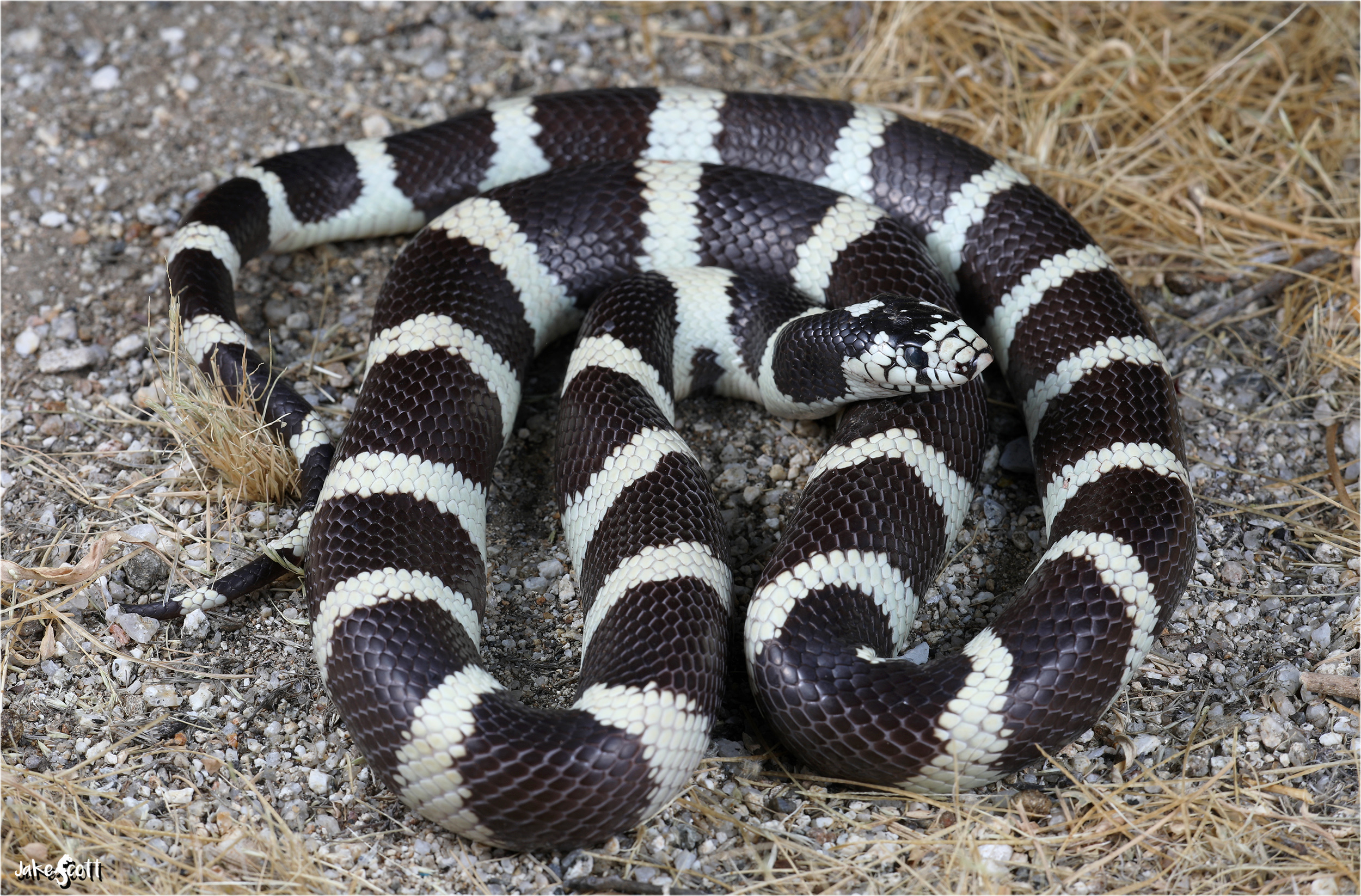
The California kingsnake is one of North America’s most beloved pet reptiles, and it’s easy to see why. It has smooth, glossy scales and typically wears a bold pattern of alternating dark and light bands, though some individuals show longitudinal stripes instead. Most adults settle in at a very manageable size, and their calm nature makes them a favorite for beginner and experienced reptile keepers alike.
What really sets this snake apart is its name: the “king” comes from its habit of hunting and eating other snakes, including venomous rattlesnakes. Kingsnakes have evolved a notable resistance to the venom of the pit vipers they prey on in their home range, letting them tackle prey that most predators wisely avoid. Despite that fearsome reputation among other reptiles, they pose no danger to people since they carry no venom at all.
Because of their manageable size, easy care, and huge variety of natural and captive-bred color patterns, California kingsnakes have become a true staple of the American reptile-keeping hobby.
This species was first scientifically described in 1835 by French naturalist Henri Marie Ducrotay de Blainville, who named it Coluber californiae after the region where it was collected. Today it’s classified as Lampropeltis californiae, part of the wider kingsnake group found across the Americas.
In the wild, the California kingsnake calls the western United States and northern Mexico home, ranging through California, Oregon, Nevada, Utah, Arizona, Colorado, and New Mexico down into Baja California. It has adapted to an impressive range of habitats, including woodland chaparral, grasslands, deserts, marshes, and even suburban neighborhoods, and can be found from near sea level up into mountain elevations of over 6,000 feet.
The pet-trade side of its history took off in the mid-20th century as early hobbyist breeders began working with striped and banded specimens, eventually producing the huge array of color “morphs” seen in captivity today. That popularity has carried the snake well beyond its native range, with captive lines now bred by enthusiasts worldwide, and it is currently listed as a species of Least Concern due to its wide distribution and stable population.
California kingsnakes are generally calm, docile animals once they settle into captivity, which is a big reason they’re so popular as pets. In the wild they’re most active during the day, though they’ll shift toward dawn, dusk, or even nighttime activity when temperatures climb in the hotter months. They spend most of their time on the ground hunting, though they can climb and swim when needed.
When startled or threatened, a kingsnake has a whole bag of defensive tricks: it may coil up to hide its head, hiss loudly, and vibrate its tail against dry leaves to mimic the warning rattle of a rattlesnake. Wild-caught individuals may also bite or release musk if handled, though captive-bred snakes usually settle down quickly and tolerate gentle handling well.
These are solitary animals by nature and should never be housed together, since kingsnakes are cannibalistic and will readily eat a cage-mate given the chance. They’re opportunistic carnivores that constrict their prey, feeding on rodents, birds, lizards, frogs, eggs, and other snakes, before slowing down for a winter brumation period when the weather turns cold.
Did you notice something that could be improved? Something wrong, or something you'd like to share, comment on, add, or remove? We'd really appreciate your help. Got general feedback or a complaint instead of a specific edit? Use our Contact Us page.
Log in to suggest an editSources: Wikipedia - https://en.wikipedia.org/wiki/California_kingsnake · Cosley Zoo - https://cosleyzoo.org/california-kingsnake/ · Los Angeles Zoo - https://lazoo.org/explore-your-zoo/our-animals/reptiles/california-kingsnake/ · A-Z Animals - https://a-z-animals.com/animals/california-kingsnake/ · ReptiChip - https://reptichip.com/blogs/animals/california-king-snake · Dimensions.com - https://www.dimensions.com/element/california-kingsnake-lampropeltis-californiae · Animalia.bio - https://animalia.bio/california-kingsnake · iNaturalist - https://www.inaturalist.org/taxa/146199-Lampropeltis-californiae · Reptiles Magazine - https://reptilesmagazine.com/california-kingsnake-care-breeding-and-morphs/ · Reptiles Magazine - https://reptilesmagazine.com/all-hail-the-california-kingsnake/ · Center for North American Herpetology - https://cnah.org/taxon.aspx?taxon=Lampropeltis_californiae · Oakland Zoo - https://www.oaklandzoo.org/animals/california-kingsnake/ · San Diego Zoo - https://animals.sandiegozoo.org/animals/kingsnake