
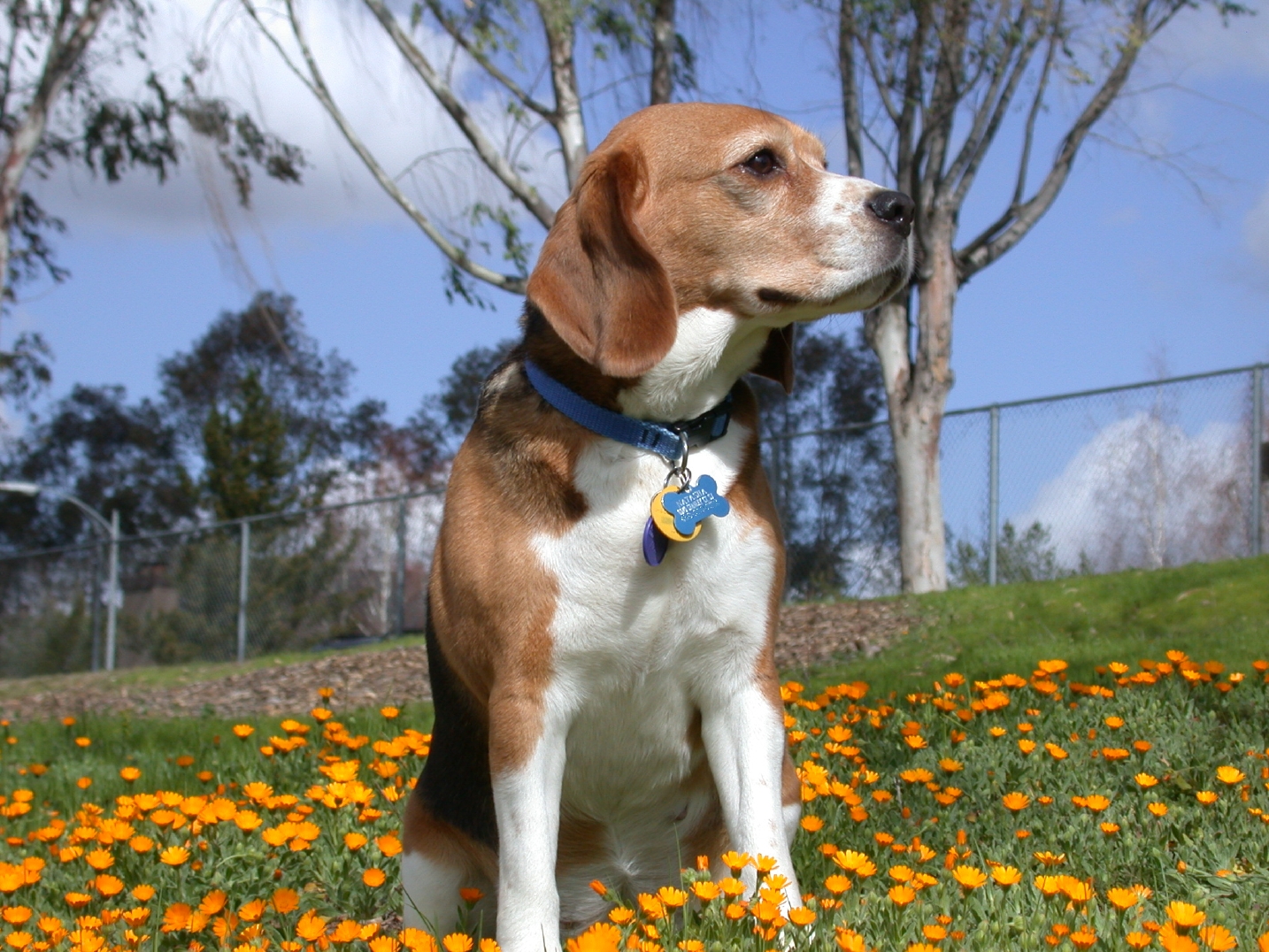
If you picture the classic hound dog with big brown eyes, floppy ears, and a tricolor coat, you’re probably picturing a Beagle. This is a small but sturdy breed that packs a lot of personality into a compact frame, and it’s easy to see why families across America keep falling for that soulful expression.
The AKC recognizes two size varieties of Beagle based on height. There’s the smaller type, which stands 13 inches or less at the shoulder and weighs under 20 pounds, and the larger type, which stands between 13 and 15 inches and weighs 20 to 30 pounds. Whichever size you get, expect a muscular, solidly built little dog with a straight back, deep chest, and a tail that’s always carried high and proud.
The coat is another signature feature: short, dense, and weather-resistant, most commonly seen in the classic black, tan, and white tricolor, though other hound colors like red and white or lemon and white are also accepted. Beagles are famous for their nose too. Their sense of smell is so refined that they’ve been enlisted for everything from rabbit hunting to sniffing out contraband food in airport luggage.
The Beagle’s story stretches back thousands of years. Ancient Greek writings from around 400 B.C. already describe small hound dogs used for tracking game, and some historians believe England had similar small hunting hounds even before the Romans arrived in 55 B.C. By the Middle Ages, the word “beagle” was being used generically for any small hunting hound, and the name itself first turned up in English literature in 1475, even getting a mention from Shakespeare.
The breed as we know it today owes a lot to one man: in the mid-1800s, Reverend Phillip Honeywood built a Beagle pack in Essex, England, focusing purely on hunting ability rather than looks, and his hounds are considered the direct ancestors of the modern Beagle. Around the same era, English royalty had a soft spot for tiny “Pocket Beagles,” small enough to be carried on horseback in a coat pocket.
Beagles crossed the Atlantic and quickly won over American hunters after the Civil War. The breed was accepted by the American Kennel Club in 1885, and it didn’t take long for Beagles to become superstars: they topped the AKC’s popularity charts from 1953 all the way through 1959, a rise that lines up neatly with the 1950 debut of a certain cartoon Beagle named Snoopy, whose fame the AKC credits with helping fuel that surge.
Today the Beagle remains one of the most recognized and best-loved breeds in the country, still ranking among the AKC’s top ten most popular dogs and continuing to work as a detection dog for the USDA at airports and border crossings.
Beagles are famously friendly, curious, and impossible to stay mad at for long. They’re outgoing, playful, and gentle, and they tend to get along beautifully with kids, other dogs, and pretty much anyone willing to scratch their ears. This is a dog that genuinely wants company and doesn’t do especially well being left alone for long stretches.
That nose, though, comes with a catch. Beagles are independent thinkers who can get distracted the moment an interesting scent crosses their path, which sometimes makes training a bit of a negotiation rather than a straightforward lesson. They’re also known for their voice: Beagles bark and howl, especially when bored or lonely, so a securely fenced yard and a leash on walks are non-negotiable, since a nose-led Beagle will absolutely wander off after a scent.
Despite their hunting-dog stamina, Beagles can be surprisingly calm house companions once their exercise needs are met. Give them a good daily walk or a chance to explore safely, and they’re happy to curl up with the family afterward. Leave them under-exercised and alone too often, though, and that same energy can turn into destructive habits or nonstop howling.
Did you notice something that could be improved? Something wrong, or something you'd like to share, comment on, add, or remove? We'd really appreciate your help. Got general feedback or a complaint instead of a specific edit? Use our Contact Us page.
Log in to suggest an editSources: American Kennel Club - Beagle History - https://www.akc.org/expert-advice/dog-breeds/beagle-history/ · American Kennel Club - Top Ten Breeds of the 1950s - https://www.akc.org/expert-advice/lifestyle/top-ten-breeds-of-the-1950s/ · Britannica - Beagle - https://www.britannica.com/animal/beagle-dog · Hill's Pet - Beagle Dog Breed - https://www.hillspet.com/dog-care/dog-breeds/beagle · Dogtime - Beagle Dog Breed Information & Characteristics - https://dogtime.com/dog-breeds/beagle · National Beagle Club of America - History - https://www.nationalbeagleclub.org/History · ShowSight Magazine - Beagle Dog Breed and Characteristics - https://showsightmagazine.com/dog-breeds/beagle/ · CareCredit - Beagle Dog Breed Guide - https://www.carecredit.com/well-u/pet-care/beagle-dog-breed/ · Wikipedia - Beagle - https://en.wikipedia.org/wiki/Beagle · Rocky Kanaka - Beagle Life Expectancy - https://rockykanaka.com/how-long-do-beagles-live-heres-everything-you-should-know-about-the-beagles-life-expectancy/