
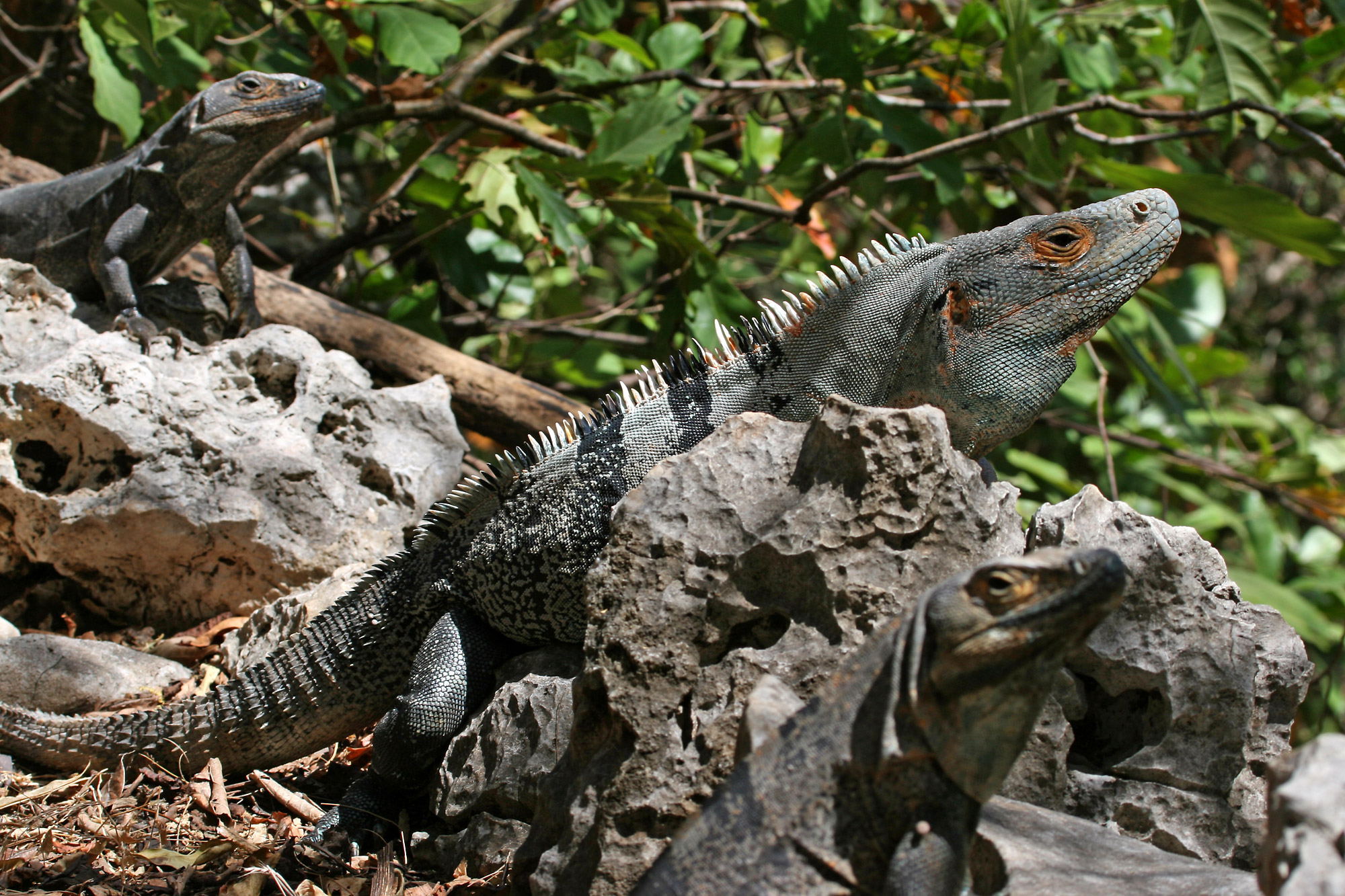
The Black Spiny-Tailed Iguana, known scientifically as Ctenosaura similis, is a big, muscular lizard that is easy to spot thanks to the row of sharp, whorled spines running down its tail and back. It’s officially the largest member of the genus Ctenosaura, and males are capable of growing up to 1.3 meters (4 ft 3 in) in length while females are slightly shorter, at 0.8 to 1 meter (2 ft 7 in to 3 ft 3 in).
Color changes a lot as these iguanas grow up. Young iguanas are olive-green in color which fades to tan, then gray and black as they mature. Adults usually settle into a whitish gray or tan ground color with a series of 4 to 12 well-defined dark dorsal bands, and during breeding season males also develop an orange color around the head and throat with highlights of blue and peach on their jowls.
These lizards aren’t just tough-looking, they’re also seriously fast. In fact, a “burst speed” of 34.6 km/h (21.5 miles/h) was recorded by a black spiny-tail iguana, which is the highest speed reported for a lizard, so it’s no surprise they can outrun most threats in a flash.
This species is native to Mexico and Central America, where it has long been a familiar sight around rocky outcrops, dry forests, and even old ruins. It’s a real habitat generalist, described as a wide-ranging habitat-generalist that is well adapted to human-altered environments, which is part of why it’s thrived for so long across such a wide range.
Humans and these iguanas have a long shared history that goes well beyond admiring them from afar. The green iguana and its relative the black iguana have been used as a food source in Central and South America for the past 7,000 years, and locals sometimes call them “gallina de palo,” or tree chicken, because of their taste.
Outside their native range, black spiny-tailed iguanas have made an unplanned home for themselves in Florida. In Florida, the Black Spiny-tailed Iguana was first introduced in 1979 and has been reported in 24 counties. That first Florida population reportedly started small: Ctenosaura similis was first reported in Florida in 1979 when a resident released 3 individuals on Gasparilla Island, and the species has since multiplied dramatically in that area.
Black spiny-tailed iguanas are social in their own tough, hierarchical way. They’re described as highly gregarious and territorial, living in colonies ruled by a strict pecking order, with a dominant male typically calling the shots. Both sexes take their turf seriously, too: both males and females will defend their perch, burrow, or shelter, and males tend to be more aggressive and have a home range including the burrows of multiple females.
They’re excellent architects and athletes. These iguanas are retreating to the burrows and tunnels they dig with their clawed feet whenever they need shelter from heat, cold, or predators, and they’re just as comfortable scaling trees, rocks, or fences to bask in the sun.
Diet shifts a lot with age. When young, spiny-tailed iguanas eat mostly insects, but as they age their diet becomes more herbivorous, and adults will also eat small birds, mammals, and other reptiles. That opportunistic streak makes them impressively adaptable eaters.
Don’t mistake their laid-back basking for tameness, though. This species can be belligerent, and may bite or wound an aggressor with their spines if it feels cornered, so respect and a bit of distance go a long way with these feisty lizards.
Did you notice something that could be improved? Something wrong, or something you'd like to share, comment on, add, or remove? We'd really appreciate your help. Got general feedback or a complaint instead of a specific edit? Use our Contact Us page.
Log in to suggest an editSources: Wikipedia - Ctenosaura similis - https://en.wikipedia.org/wiki/Ctenosaura_similis · Wikipedia - Ctenosaura (genus) - https://en.wikipedia.org/wiki/Ctenosaura · Animal Diversity Web - Ctenosaura similis - https://animaldiversity.org/accounts/Ctenosaura_similis/ · EDDMapS - Black spiny-tailed iguana - https://www.eddmaps.org/species/subject.cfm?sub=18182 · Southeastern Naturalist - A Species Profile for the Black Spiny-Tailed Iguana - https://bioone.org/journals/southeastern-naturalist/volume-22/issue-3/058.022.0303/A-Species-Profile-for-the-Black-Spiny-Tailed-Iguana-Ctenosaura/10.1656/058.022.0303.short · The Canopy Family - Black Ctenosaur - https://canopytower.com/black-ctenosaur/ · Anywhere Travel Agency - The Black Ctenosaur - https://www.anywhere.com/flora-fauna/reptile/black-ctenosaur · ZooAmerica - Spiny-tailed Iguana - https://www.zooamerica.com/animals/spiny-tailed-iguana/ · Wikipedia - Green iguana - https://en.wikipedia.org/wiki/Green_iguana · PubMed - Invasive black spiny-tailed iguanas (Ctenosaura similis) on Gasparilla Island - https://pubmed.ncbi.nlm.nih.gov/24382291/ · AnAGE (Human Ageing Genomic Resources) - Ctenosaura similis - https://genomics.senescence.info/species/entry.php?species=Ctenosaura_similis