
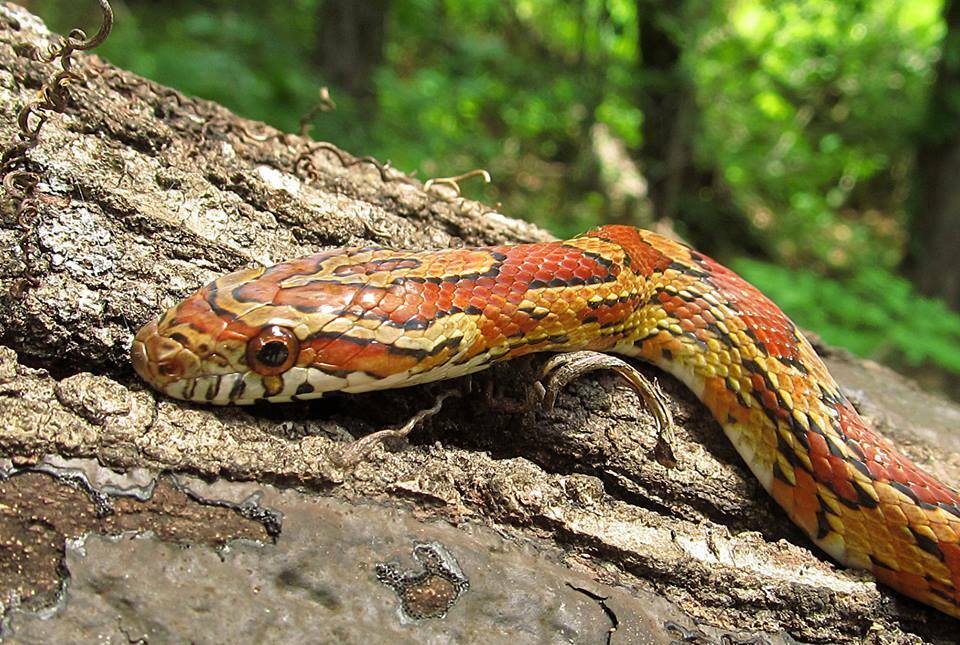
The corn snake is one of the most beloved pet snakes in the world, and it’s easy to see why. This North American species of rat snake subdues its small prey by constriction and is a non-venomous constrictor. Their docile nature, reluctance to bite, moderate adult size, attractive pattern, and comparatively simple care make them commonly kept pet snakes.
As adults, corn snakes are approximately 61 to 182 centimeters (24 to 72 inches) long. They are slender, orange or brownish-yellow snakes with a pattern of large, red blotches down their backs, and along their bellies are distinctive rows of alternating black and white marks, which resemble a checkerboard pattern. Thanks to decades of selective breeding, though, wild coloring is really just the starting point – keepers have developed a rainbow of variations.
One funny quirk of the corn snake is that though it superficially resembles the venomous copperhead and is often killed as a result of this mistaken identity, it is harmless and beneficial to humans. In reality, this gentle reptile is far more interested in rodents than in bothering people, making it a great fit for households that want an easy-to-manage, good-looking snake.
Corn snakes have a long scientific paper trail. Carolus Linnaeus originally described this species as Coluber guttatus in 1766 from a specimen sent to him from “Carolina” by Alexander Garden, and the species name comes from Latin guttatus, meaning “spotted, speckled,” in reference to the snake’s skin pattern. Over the years taxonomists moved it between genera before it landed in its current one, Pantherophis.
As for the common name, there are two popular theories. The corn snake is named for the species’ regular presence near grain stores, where it preys on mice and rats that eat harvested corn, a usage the Oxford English Dictionary cites as far back as 1675. The belly also has a distinctive black and white checkerboard pattern, the “corn” belly that gives this species one of its common name theories.
In the wild, corn snakes are found in the eastern United States from southern New Jersey to Florida, into Louisiana and parts of Kentucky, and are most abundant in Florida and other southeastern states. Its journey into households really took off decades ago: corn snakes have been captive bred in the USA and Europe for over 60 years, and are renowned for their ease of care and breeding. The corn snake with its distinctive name and iconic patterns became a symbolic icon of the exotic pet boom in the 1980s, and today remains among the most popular pet snakes due to its docile characteristics and reliable availability.
Because it travels so well in the pet trade, the species has also unintentionally spread far beyond its home range. Introduced populations have been recorded on several islands in the Caribbean, with established populations in the Bahamas, Grand Cayman, the U.S. Virgin Islands, and the Lesser Antilles.
If you’re picturing a snake curled up hissing in a corner, the corn snake will probably surprise you. Captive corn snakes tolerate being held for an extended period and are also relatively calm, which is a huge part of why so many first-time snake owners choose them.
In terms of daily rhythm, corn snakes split opinion a bit among experts, but most describe them as active around dawn and dusk. Once dusk falls, corn snakes shift into gear, showing crepuscular activity peaks as they emerge to hunt, spending daylight hours tucked into rodent burrows, rock crevices, or loose bark. They’re also surprisingly athletic: their climbing ability is truly fantastic, their body is perfectly designed for it, and people find them in very odd places, sometimes even wedging themselves into the grout lines in brick walls.
When it comes to defense, corn snakes are far from aggressive. Their defensive repertoire includes freezing, fleeing, musking, vibrating the tail in dry leaves like a convincing “rattle”, or striking without envenomation when cornered. Most of the time, though, a well-socialized corn snake would much rather just slip away or settle calmly into your hands than put on a show.
As hunters, they rely on brute efficiency rather than speed. These constrictors bite their prey to get a firm grip, then quickly coil themselves around their meal, squeezing tightly until the prey is subdued, and finally swallow their food whole, usually headfirst. It’s a no-nonsense approach that has served the species well for a very long time.
Did you notice something that could be improved? Something wrong, or something you'd like to share, comment on, add, or remove? We'd really appreciate your help. Got general feedback or a complaint instead of a specific edit? Use our Contact Us page.
Log in to suggest an editSources: Smithsonian's National Zoo - https://www.nationalzoo.si.edu/node/10454 · Smithsonian's National Zoo (Eastern corn snake) - https://nationalzoo.si.edu/animals/eastern-corn-snake · Reptilia Zoo - https://reptilia.org/corn-snake/ · iNaturalist (Reptiles of Alabama guide) - https://www.inaturalist.org/guide_taxa/393515 · Wikipedia - Corn snake - https://en.wikipedia.org/wiki/Corn_snake · Virginia Herpetological Society - https://www.virginiaherpetologicalsociety.com/reptiles/snakes/corn-snake/ · Exo-Terra Care Guide - https://exo-terra.com/explore/care-guides/snakes/pantherophis-guttatus/ · ExoticsKeeper - https://exoticskeeper.com/blog/corn-snakes-in-the-wild-amp-history-of-captive-breeding/ · A-Z Animals - https://a-z-animals.com/animals/corn-snake/ · SnakeSnuggles - https://snakesnuggles.com/corn-snake-natural-habitat-and-care/ · ReptileDirect - https://reptiledirect.com/corn-snake/