
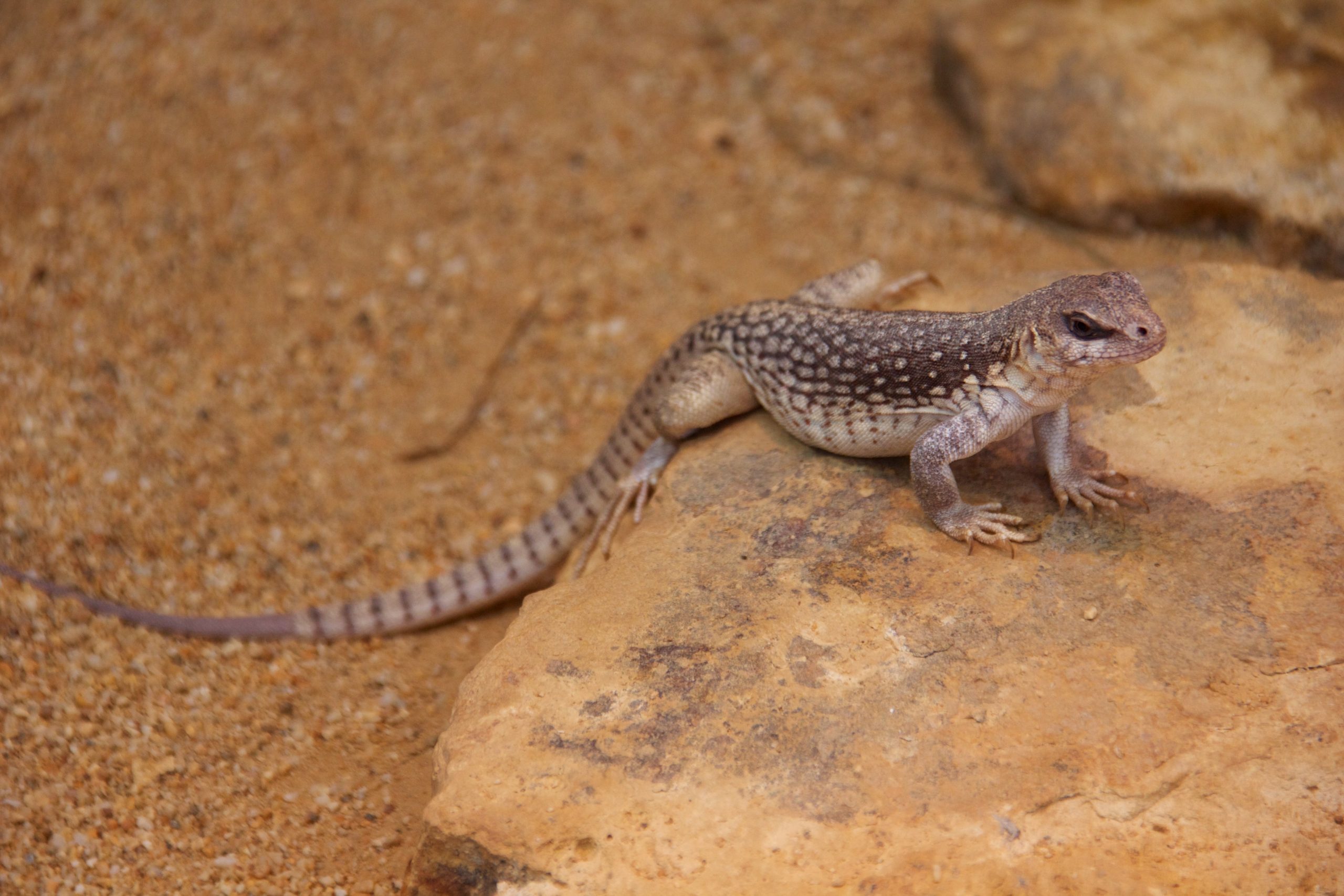
The desert iguana is a sturdy, medium-sized lizard built for life in some of the hottest places in North America. It has a stout, rounded body, a blunt head, and a long tail that is usually a little less than twice the length of its body. Its coloring is a pale gray-tan to cream shade with a light brown, net-like pattern across the back and sides that fades into a pale, unmarked belly.
One feature that really sets this lizard apart is the row of slightly enlarged, keeled scales running down the center of its back, forming a small crest. This is actually a rare trait among lizards native to the United States. Desert iguanas are also famous for how much heat they can handle, staying active at body temperatures that would shut down most other reptiles.
Adults typically measure between 10 and 16 inches long including the tail, occasionally reaching up to 18 inches, and weigh only about 2 to 3 ounces. Despite their small size, they are tough, resourceful little survivors of the desert.
The desert iguana was first described back in 1852 by naturalists Spencer Fullerton Baird and Charles Frederic Girard, who originally classified it under a different genus name. A couple of years later, herpetologist Edward Hallowell created the genus Dipsosaurus specifically for this species, and the name has stuck ever since.
The scientific name itself tells a little story: Dipsosaurus comes from the Greek word for “thirsty,” essentially making this the “thirsty lizard,” while dorsalis refers to the Latin word for the spiky crest of scales running down its back. Genetic studies have also revealed something pretty remarkable about this species: it appears to be the most basal, or earliest-branching, living member of the iguana family, having split off from its iguanid relatives roughly 38 million years ago during the late Eocene.
Today desert iguanas are found throughout the Sonoran and Mojave Deserts, ranging across southeastern California, southern Nevada, southwestern Utah, and parts of Arizona, and into Baja California and northwestern mainland Mexico, plus a scattering of Gulf of California islands. Their whole distribution is closely tied to one plant in particular, the creosote bush, which provides them food, shade, and shelter throughout their range.
Unlike most desert animals that hide from the midday sun, the desert iguana comes out to play in it. These lizards are diurnal and most active right when temperatures peak, often foraging and basking for hours in heat that would send other creatures scrambling for shade. This bold heat tolerance actually works in their favor, since many predators simply cannot function in that kind of scorching weather.
Most of their diet is made up of plants, especially the yellow flowers, buds, and leaves of the creosote bush, though they will occasionally snack on ants, other insects, or even carrion when the opportunity arises. When they are not eating, they spend a lot of time digging and maintaining burrows at the base of shrubs, and they are not above borrowing a burrow from a kit fox or desert tortoise if a ready-made one is available.
When danger does show up, desert iguanas have several tricks: their blotchy coloring helps them melt into the gravelly desert floor, they can dash into a burrow or up into a bush, and if a predator catches their tail, it will detach and keep wriggling on the ground while the lizard makes its getaway. During breeding season in spring and early summer, males turn territorial and combative, engaging in push-up contests to assert dominance, and both sexes develop a pinkish blush along their sides.
Outside of mating rivalries, these lizards are fairly solitary and low-key, going about their business of basking, foraging, and burrowing without much fuss. Their generally gentle, easygoing temperament combined with their manageable size is part of why some reptile keepers find them appealing, even though they are not common pets.
Did you notice something that could be improved? Something wrong, or something you'd like to share, comment on, add, or remove? We'd really appreciate your help. Got general feedback or a complaint instead of a specific edit? Use our Contact Us page.
Log in to suggest an editSources: Animal Diversity Web (Dipsosaurus dorsalis) - https://animaldiversity.org/accounts/Dipsosaurus_dorsalis/ · Dimensions.com - Desert Iguana - https://www.dimensions.com/element/desert-iguana-dipsosaurus-dorsalis · Reptiles Magazine - Desert Iguana Natural History And Care - https://reptilesmagazine.com/desert-iguana-natural-history-and-care/ · Arizona-Sonora Desert Museum - Desert Iguana - https://www.desertmuseum.org/books/nhsd_desert_iguana.php · Phoenix Zoo - Desert Iguana - https://www.phoenixzoo.org/explore/animals/desert-iguana/ · AnimalSpot - Desert Iguana - https://www.animalspot.net/desert-iguana.html · Nevada Department of Wildlife - Desert Iguana - https://www.ndow.org/species/desert-iguana/ · Wikipedia - Desert iguana - https://en.wikipedia.org/wiki/Desert_iguana · Wikipedia - Iguanidae - https://en.wikipedia.org/wiki/Iguanidae · UC Berkeley News - Iguanas floated one-fifth of the way around the world to colonize Fiji - https://news.berkeley.edu/2025/03/17/iguanas-floated-one-fifth-of-the-way-around-the-world-to-colonize-fiji/ · Dubia Roaches - Desert Iguana Care Sheet - https://dubiaroaches.com/blogs/lizard-care/desert-iguana-care-sheet