
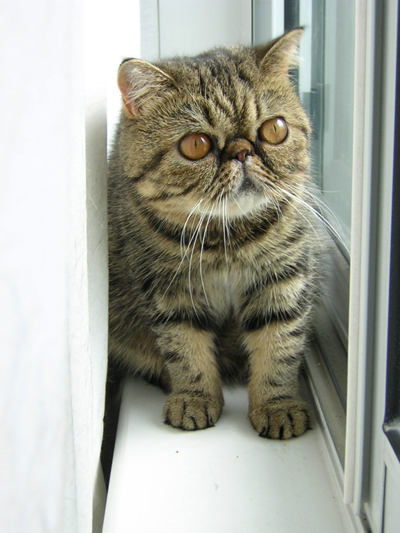
Picture a fluffy little teddy bear with a permanently sweet, sleepy expression, and you’ve basically pictured the Exotic Shorthair. This breed was created as a short-coated version of the Persian, so it shares that same round head, big round eyes, short muzzle, and stocky, compact body, just without all the daily brushing a Persian demands.
What really sets the Exotic apart is that plush, dense coat, which stands slightly off the body and gives the cat a soft, huggable, almost stuffed-animal look. These adorable cats have luxuriously dense coats that are medium in length and stand off from their bodies, giving them the appearance of a fluffy feline teddy bear. They come in just about every color and pattern imaginable, mirroring the huge palette found in Persians.
Despite the glamorous look, the Exotic is refreshingly low-maintenance for a Persian-type cat, and its calm, easygoing nature makes it a favorite for people who want a gentle, cuddly companion without a ton of grooming work.
The story of the Exotic Shorthair started almost by accident back in the 1950s. In the early 1960s, American Shorthair breeders began using Persians as outcrosses in an attempt to strengthen their type, but the resulting kittens were unique and had a decidedly different appearance than they were looking for. Those surprise kittens had the plush Persian look but with a short, easy coat, and breeders quickly fell in love with them instead of trying to correct the “mistake.”
Other catteries got in on the experiment too. Other breeders brought in Burmese or Russian Blues to get the gene for the short coat. Since the new cats didn’t fit neatly into any existing breed, breeders working with the hybrid lines decided to work on a new breed to be called the Exotic Shorthair.
The breed was officially welcomed into the cat fancy in the late 1960s. The new breed was officially recognized in 1966 by the Cat Fanciers’ Association and the Exotic Shorthair quickly gained popularity throughout the world. At first, outcrossing to Russian Blues and Burmese was still allowed, but outcrossing the breed with Russian Blues and Burmese was allowed until 1987 when the CFA decided to only allow crossing with Persians. Today the Exotic remains one of the most beloved breeds in North America, ranking just behind its longhaired cousin in popularity.
If you love the idea of a Persian’s sweet personality but want a cat with a bit more pep, the Exotic fits the bill perfectly. He has the sweet, gentle face of the Persian, as well as the same body type, but is somewhat livelier, a nod to his American Shorthair heritage. That said, don’t expect a hyperactive climber; this is very much a laid-back lap cat at heart.
Exotics tend to be quiet, undemanding companions rather than needy ones. They are devoted but not intrusive, content to remain close to you without requiring inclusion in your activities. They’re not big talkers either, letting out only the occasional soft sound rather than constant chatter, and males often warm up to people a bit faster than the more independent females.
Because of their gentle, adaptable nature, Exotics settle happily into calm households and apartments alike. They have a mellow and calm temperament, best suited for quiet households and apartment dwellings, and make a perfect breed for active people who like the look of Persians but don’t have time to deal with the high grooming needs. They’ll still enjoy a good chase with a favorite toy now and then, but at the end of the day, curling up on a warm lap is really what they live for.
Did you notice something that could be improved? Something wrong, or something you'd like to share, comment on, add, or remove? We'd really appreciate your help. Got general feedback or a complaint instead of a specific edit? Use our Contact Us page.
Log in to suggest an editSources: Cat Fanciers' Association - https://cfa.org/breed/exotic/ · Trupanion - https://www.trupanion.com/pet-blog/article/exotic-shorthair · GCCF (Governing Council of the Cat Fancy) - https://www.gccfcats.org/getting-a-cat/choosing/cat-breeds/exotic-shorthair/ · VCA Animal Hospitals - https://vcahospitals.com/know-your-pet/cat-breeds/exotic-shorthair · Vetstreet - https://www.vetstreet.com/cats/exotic-shorthair · PetMD - https://www.petmd.com/cat/breeds/exotic-shorthair · Cat Fanciers (fanciers.com) FAQ - https://fanciers.com/cat-breeds-a-l/exotic-faq/ · Wikipedia - https://en.wikipedia.org/wiki/Exotic_Shorthair · Dimensions.com - https://www.dimensions.com/element/exotic-shorthair-cat · Pet Health Network - https://www.pethealthnetwork.com/cat-health/cat-breeds/exotic-shorthair