
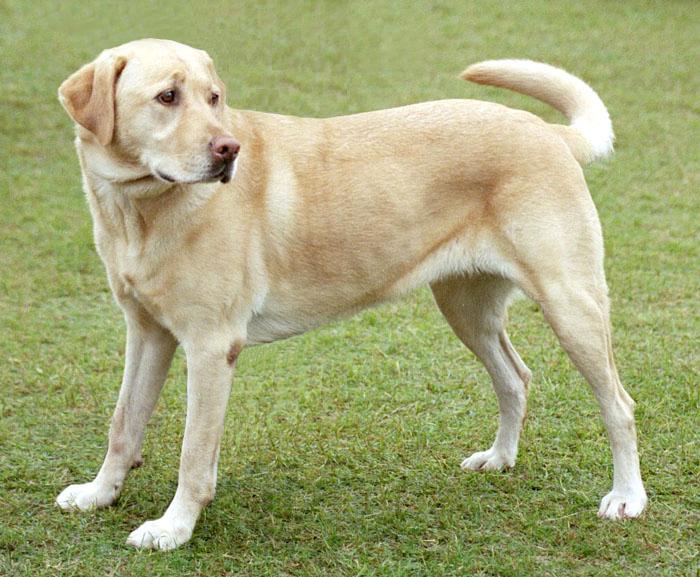
The Labrador Retriever is that friendly, tail-wagging dog everyone seems to know, and it’s easy to see why. According to the AKC, this sweet-faced, lovable breed is America’s most popular dog, known for being a friendly, outgoing, and high-spirited companion who has more than enough affection to go around for a family looking for a medium-to-large dog.
Built to work, the Lab has a strongly built, medium-sized frame with a short, dense, weather-resistant coat, a broad head, and that unmistakable thick otter tail that acts like a rudder in the water. They come in three official colors recognized by kennel clubs: black, chocolate, and yellow, with yellow ranging anywhere from pale cream to a deep fox-red.
What really sets Labs apart is their temperament. The AKC describes the ideal disposition as kindly, outgoing, and tractable, eager to please and non-aggressive towards man or animal, which is exactly why they excel as family pets, service dogs, and hunting companions all at once.
Whether lounging on the couch or diving into a lake after a ball, the Lab’s combination of brains, brawn, and gentle heart keeps it near the top of nearly every popularity list in the country.
Despite the name, Labradors didn’t actually come from Labrador. They trace back to Newfoundland, Canada, descending from the St. John’s water dog, a smaller cousin of the Newfoundland breed that helped local fishermen haul nets and retrieve fish that slipped the line in icy Atlantic waters.
In the 1800s, English nobles visiting Canada fell in love with these hardy little water dogs and began bringing them back to Britain. There, aristocrats like the Earl of Malmesbury and later breeders refined the type into the retriever we know today, valuing its soft mouth, water resistance, and sharp intelligence for waterfowl hunting.
The breed was officially established in England in 1903, and pedigrees for foundational dogs can be traced back to 1878. The American Kennel Club followed by registering its first Labrador in 1917, and the Labrador Retriever Club was formally organized in the United States in the early 1930s.
From there, the Lab’s popularity only grew. Beginning in 1991, it began an uninterrupted run at the top of AKC’s registration statistics, ultimately holding the number one spot for 31 straight years, a record no other breed has matched, before eventually settling into a very close second place.
If there’s one word that sums up a Labrador’s personality, it’s friendly. Labs are not only warm to their owners, but tend to get along well with strangers and other dogs too, and their playful, easygoing nature helps them adapt to just about any environment.
Don’t expect a great watchdog, though. Labs are vigilant, but they don’t have the strongest guardian instincts, they’re much more likely to greet an intruder with a wagging tail than a growl. What they do bring is serious brainpower and a strong work ethic, since these are dogs bred to work and work hard, and they genuinely love having a job to do, especially retrieving.
That energy needs an outlet. Owing to their energetic nature, Labradors who are left alone or not well exercised can become destructive, chewing, digging, and barking to excess, so daily walks, play, and swimming really matter for keeping a Lab happy and well-behaved.
Good news for families: Labs are usually good with other dogs, other pets, and children as long as training has toned down their natural exuberance early on. With a bit of structure, that boundless enthusiasm turns into one of the most devoted, adaptable companions around.
Did you notice something that could be improved? Something wrong, or something you'd like to share, comment on, add, or remove? We'd really appreciate your help. Got general feedback or a complaint instead of a specific edit? Use our Contact Us page.
Log in to suggest an editSources: American Kennel Club - Labrador Retriever Dog Breed Information - https://www.akc.org/dog-breeds/labrador-retriever/ · American Kennel Club - Is the Labrador Retriever the Right Dog Breed for You? - https://www.akc.org/expert-advice/dog-breeds/labrador-retriever-right-for-you/ · American Kennel Club - Official Standard for the Labrador Retriever - https://images.akc.org/pdf/breeds/standards/LabradorRetriever.pdf · American Kennel Club - Facts About the Labrador Retriever That You May Not Know - https://www.akc.org/expert-advice/lifestyle/fun-facts-labrador-retrievers/ · American Kennel Club - Labrador Retrievers Rank Most Popular for 29th Straight Year - https://www.akc.org/expert-advice/news/labrador-retriever-most-popular-breed-29th-year-row/ · American Kennel Club - Most Popular Dog Breeds - https://www.akc.org/most-popular-breeds/ · American Kennel Club - Most Popular Dog Breeds of 2022 - https://www.akc.org/expert-advice/dog-breeds/most-popular-dog-breeds-2022/ · Hill's Pet - Labrador Retriever Dog Breed - https://www.hillspet.com/dog-care/dog-breeds/labrador-retriever · Wikipedia - Labrador Retriever - https://en.wikipedia.org/wiki/Labrador_Retriever · United Kennel Club - Labrador Retriever Breed Standard - https://www.ukcdogs.com/labrador-retriever · Orvis - Labrador Retriever - https://www.orvis.com/labrador-retriever.html · Embrace Pet Insurance - 7 Fun Facts You Probably Didn't Know About Labrador Retrievers - https://www.embracepetinsurance.com/waterbowl/article/7-fun-facts-about-labrador-retrievers