
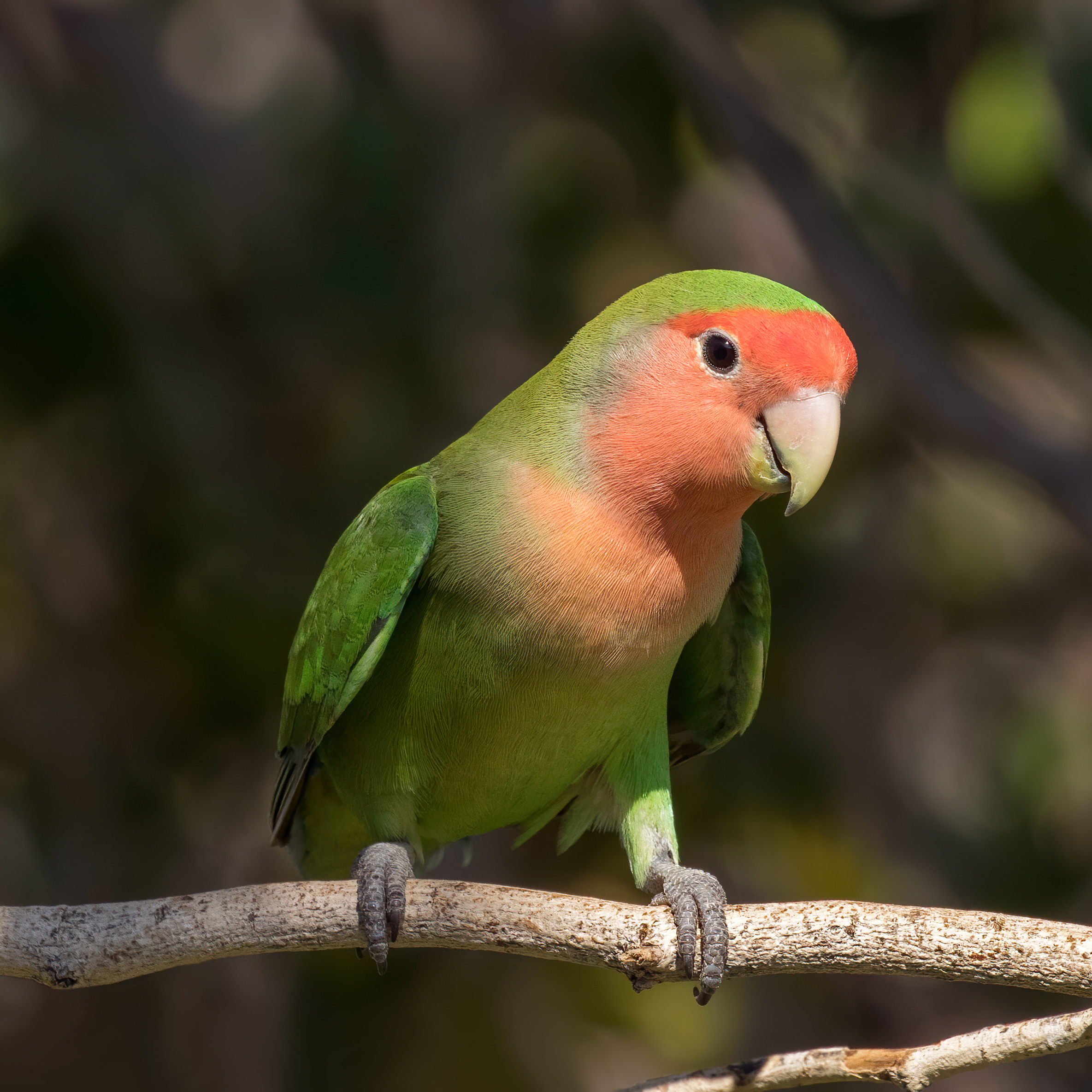
The Peach-Faced Lovebird is a pint-sized parrot with a personality far bigger than its body. Weighing barely more than a couple of coins, this little green bird is instantly recognizable by the warm peachy-pink blush across its face and throat, a shiny blue rump, and a stocky, short-tailed build typical of the lovebird family.
Don’t let the small size fool you: these are true parrots, sharing the curiosity, intelligence, and busy energy of their bigger cousins. Breeders have also developed dozens of stunning color mutations over the years, so pet lovebirds today can show up in shades of blue, yellow, white, and violet, not just the classic green-and-peach look.
Whether kept singly or in pairs, Peach-Faced Lovebirds are known for filling a room with chatter, climbing gear, and constant motion, making them one of the most popular small parrots kept as companions in the United States today.
This species comes from the dry, rocky landscapes of southwestern Africa, particularly Namibia and neighboring Angola, where wild flocks still live today. It was first formally described by French ornithologist Louis Pierre Vieillot in 1818, originally as Psittacus roseicollis before scientists later placed it in the lovebird genus Agapornis alongside its eight relatives.
In the wild, these birds are homebodies of the arid bush, favoring dry woodland, scrubby hillsides, and land near water, where they gather in flocks that can number in the hundreds when food is plentiful. Peach-Faced Lovebirds entered the exotic pet trade decades ago and became wildly popular thanks to their small size, easy care, and outgoing nature.
Interestingly, escaped or released pet birds gave rise to a thriving feral population in Phoenix, Arizona, first noticed in the 1980s, where the birds now nest in cactus holes and palm trees and even cluster around air-conditioning vents to beat the desert heat.
Peach-Faced Lovebirds are famous for their strong pair bonds, snuggling side by side and turning their faces toward each other when they sleep, which is exactly how the whole lovebird family earned its affectionate name. They’re highly social, vocal, and endlessly curious, spending their days climbing, chewing, foraging, and chattering to anyone who will listen.
That big personality comes with a flip side: these birds can be sassy, a little bossy, and even scrappy toward other pets or unfamiliar birds if they feel their territory or their favorite person is threatened. They bond intensely, whether to a human or another lovebird, and need daily interaction and mental stimulation to stay happy, since a bored or lonely lovebird can become noisy or start plucking its feathers.
Despite the occasional attitude, most owners find them irresistibly entertaining companions that thrive on play, toys, and busy beaks, and while they aren’t known for mimicking speech, they can learn simple words and plenty of fun tricks.
Did you notice something that could be improved? Something wrong, or something you'd like to share, comment on, add, or remove? We'd really appreciate your help. Got general feedback or a complaint instead of a specific edit? Use our Contact Us page.
Log in to suggest an editSources: Lafeber Co. - Peach-Faced Lovebird - https://lafeber.com/pet-birds/species/peach-faced-lovebird/ · VCA Animal Hospitals - Lovebirds General - https://vcahospitals.com/know-your-pet/lovebirds---general · Parrot Essentials - Peach-Faced Lovebird Profile & Care Guide - https://parrotessentials.co.uk/peach-faced-lovebird-profile · Wikipedia - Rosy-faced lovebird - https://en.wikipedia.org/wiki/Rosy-faced_lovebird · Wikipedia - Lovebird - https://en.wikipedia.org/wiki/Lovebird · Oiseaux-Birds - Peach-faced Lovebird - https://www.oiseaux-birds.com/card-peach-faced-lovebird.html · Audubon - When It Gets Too Hot, Phoenix's Lovebirds Turn to Air Conditioning - https://www.audubon.org/news/when-it-gets-too-hot-phoenixs-lovebirds-turn-air-conditioning · Maricopa Bird Alliance - Peach-faced Lovebird - https://www.maricopaaudubon.org/peachfaced-lovebird · The Vet Desk - Peach-Faced Lovebird Info, Personality, Care Guide - https://thevetdesk.com/pet-breeds/birds/peach-faced-lovebird/ · Susan Clubb - Peach Faced Lovebirds - https://susanclubb.com/knowledge-center/bird-species-profiles/21-lovebirds/101-peach-faced-lovebirds · Herebird - Peach Faced Lovebird Care Guide - https://www.herebird.com/peach-faced-lovebirds/ · Birds of Nebraska Online - Rosy-faced (Peach-faced) Lovebird - https://birds.outdoornebraska.gov/rosy-faced-peach-faced-lovebird/