
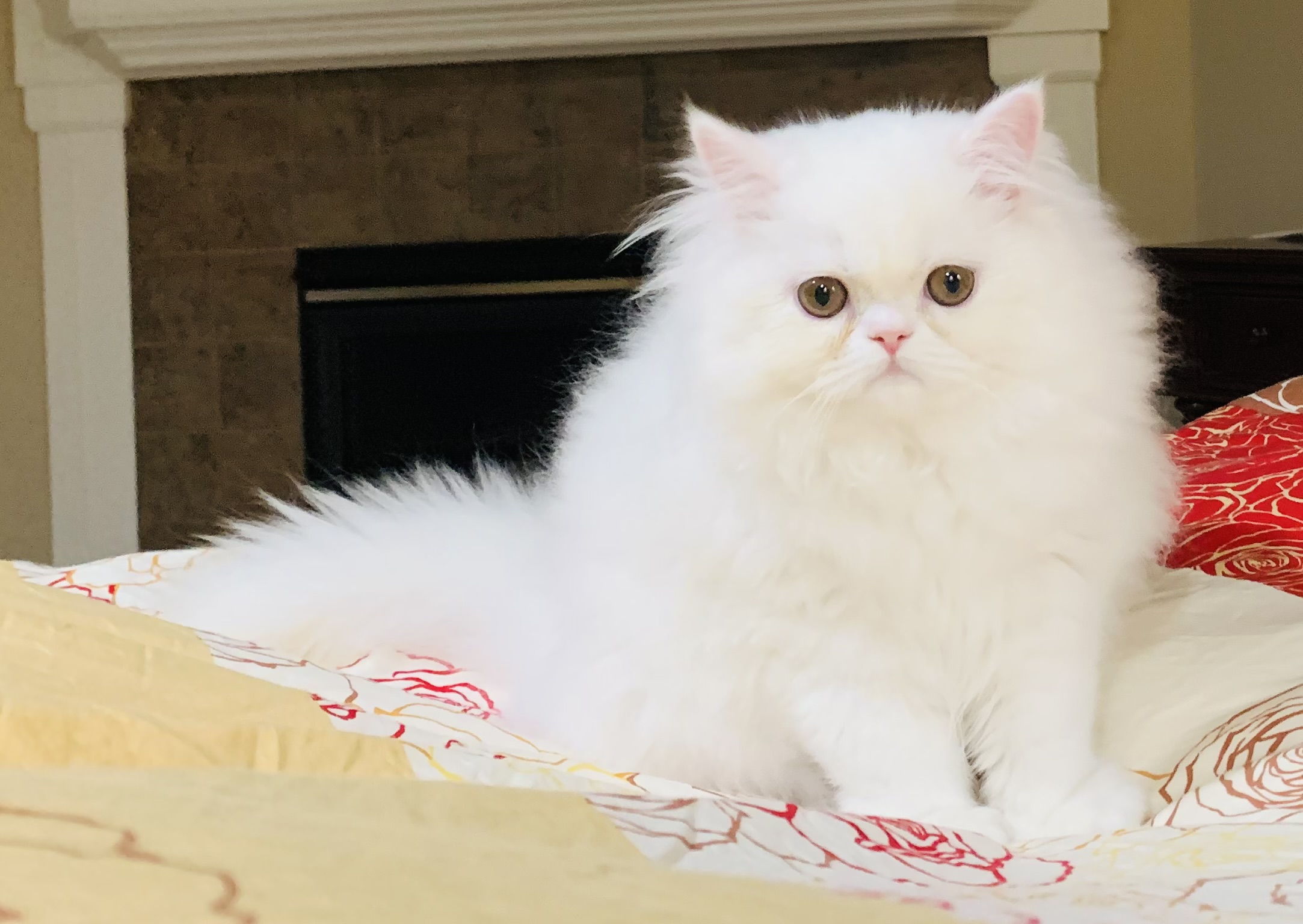
If you picture the ultimate lap cat, chances are you’re picturing a Persian. These are medium to large cats with a low-slung, heavily boned body that breeders call “cobby” — broad chest, short thick legs, and a rounded middle that all add up to a solid, huggable armful of fur.
The face is round and sweet, framed by small rounded ears and set off by huge, expressive round eyes that come in colors matched to the coat. Their crowning glory is of course the coat itself: long, thick, and silky, standing away from the body and coming in dozens of colors and patterns, from solid white or black to silver tabbies, smokes, calicos, and bicolors.
Despite their glamorous show-cat looks, Persians are famously mellow. They aren’t jumpers or climbers, and they’re far happier curled up on a soft cushion than leaping onto the top of the fridge.
The Persian’s story starts, unsurprisingly, somewhere near Persia — modern-day Iran — and the exact details are lost to time. What is documented is that an Italian traveler named Pietro della Valle brought long-haired cats back from the region in 1620, while around the same time another Frenchman imported similar long-haired cats from Turkey.
These early imports were often lumped together with Turkish Angoras, since both were exotic, long-coated newcomers to Europe. Over the next couple of centuries British and French breeders gradually pulled the two apart, favoring the Persian’s heavier bone, rounder head, and plusher coat, and by the 1800s the breed had become a fixture among European nobility, famously including Queen Victoria.
The Persian we recognize today — with its extremely flat face — is largely an American creation from the 20th century; breeders kept selecting for a shorter nose and rounder profile decade after decade, and by the 1960s the modern look had emerged. The first official Longhair standard was actually adopted by early cat fanciers back in 1914, and Persians have remained one of the most registered breeds ever since.
Persians are the definition of laid-back. They’re calm, even-tempered cats that would rather receive affection from their favorite humans than go chasing toys around the house, though they will happily bat at a feather teaser now and then.
They bond deeply with their families and get along well with gentle children, other cats, and even dogs, but they can take a little time to warm up to strangers or a chaotic household — loud, unpredictable environments just aren’t their style.
Because that gorgeous coat doesn’t take care of itself, Persians need daily brushing and combing to prevent painful mats, plus routine eye cleaning thanks to their flat faces. The upside is that they’re easy to train: they learn the word “no” quickly and many even learn to answer to their names, making the grooming routine much easier once they’re used to it from kittenhood.
Did you notice something that could be improved? Something wrong, or something you'd like to share, comment on, add, or remove? We'd really appreciate your help. Got general feedback or a complaint instead of a specific edit? Use our Contact Us page.
Log in to suggest an editSources: Cat Fanciers' Association - Persian Breed Page - https://cfa.org/breed/persian/ · Chewy - Persian Cat Breed - https://www.chewy.com/education/cat-breeds/persian-cat · Wikipedia - Persian cat - https://en.wikipedia.org/wiki/Persian_cat · Modern Cat - The Persian Cat: Personality, Characteristics & Care - https://moderncat.com/articles/breeds/the-persian-cat-personality-characteristics-care/ · Dimensions.com - Persian Cat Dimensions & Drawings - https://www.dimensions.com/element/persian-cat · Hill's Pet - Persian Cat Breed - https://www.hillspet.com/cat-care/cat-breeds/persian · CFA Persian Breed Council - Persian History, Part 1 - https://www.persianbc.org/history1.php · Mental Floss - 10 Fancy Facts About Persian Cats - https://www.mentalfloss.com/article/71010/10-fancy-facts-about-persian-cats · Wikipedia - Exotic Shorthair - https://en.wikipedia.org/wiki/Exotic_Shorthair · CFA - Persian Solid Article 1995 - https://cfa.org/persian-solid-article-1995/ · Pumpkin Pet Insurance - 14 Interesting Facts About Persian Cats - https://www.pumpkin.care/post/persian-cats-facts-lifespan