
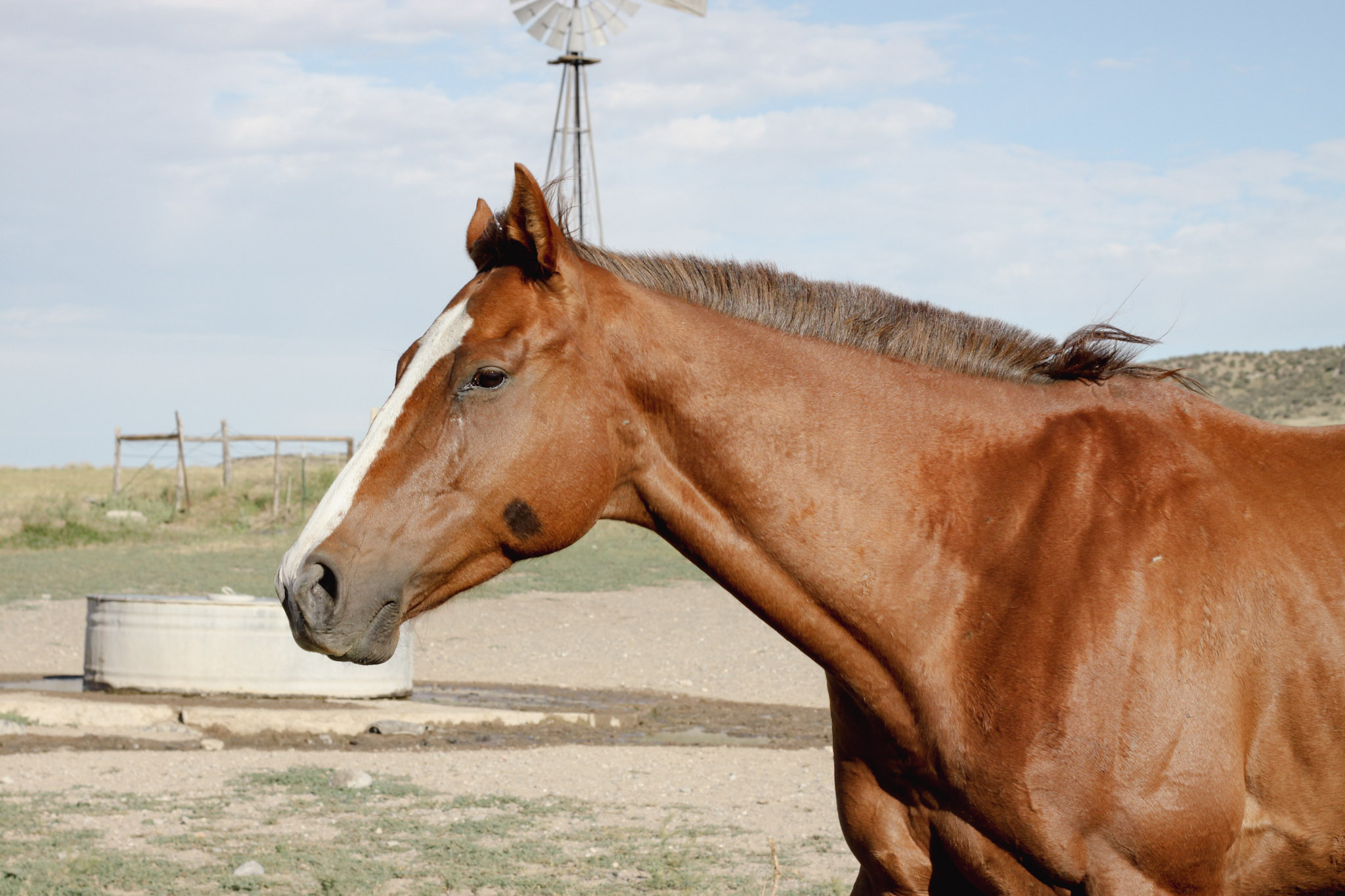
The Thoroughbred is the ultimate racing machine of the horse world – lean, long-legged, and built for pure speed.
Averaging around 16 hands high and weighing about 1,000 pounds at maturity, this hot-blooded breed has a refined, athletic build with a deep chest, sloping shoulders, and long legs that give it an incredibly efficient stride. Coats are almost always solid colors, with bay, chestnut, brown, black, and gray being the most common.
What really sets the Thoroughbred apart is its combination of raw speed and stamina. These horses have been clocked at nearly 44 miles per hour, and their oversized hearts and lungs let them keep up near-maximum effort longer than most other breeds can manage.
Beyond the racetrack, Thoroughbreds are prized all-rounders, competing successfully in dressage, show jumping, eventing, polo, and fox hunting once their racing days are done.
The Thoroughbred’s story begins in 17th and 18th century England, when breeders crossed native English mares with imported Arabian, Barb, and Turkoman stallions in pursuit of a faster, more athletic racehorse. Every modern Thoroughbred traces its male line back to just three foundation sires – the Byerley Turk, the Darley Arabian, and the Godolphin Arabian – each brought over from the Middle East and bred to the sturdier, if less flashy, native stock.
To keep track of this new breed’s pedigrees, James Weatherby published the first volume of the General Stud Book in 1791, listing pedigrees of hundreds of foundation mares that could be traced back to those three famous stallions. This closed studbook system, still used today by the Jockey Club and its counterparts around the world, is part of why the Thoroughbred remains such a genetically distinct breed.
The sport that shaped the breed had royal backing too, gaining serious momentum in Britain under Charles II, a horse racing enthusiast, in the 17th century. From England the breed quickly spread across the globe, and today the United States has become the world’s largest producer of Thoroughbreds.
Legends like Man o’ War, Secretariat, and Seabiscuit turned the breed into a cultural phenomenon, with horses such as Secretariat setting Triple Crown track records in 1973 that remarkably still stand today.
Thoroughbreds are famous for being intelligent, sensitive, and full of energy – qualities that make them incredibly responsive under saddle but also mean they need a confident, experienced hand. Their alert nature and strong work ethic make them quick learners, but that same sensitivity can make them reactive if handling is inconsistent or rushed.
Temperament actually varies quite a bit between individuals – some Thoroughbreds are calm and business-like from day one, while others carry more nervous energy, especially fresh off the racetrack. What tends to help across the board is a stable routine and patient, steady handling, since these horses generally don’t respond well to unpredictability.
Despite their racing reputation, plenty of Thoroughbreds settle beautifully into second careers once retrained. Many go on to become successful dressage, show jumping, and eventing partners, and organizations like the Jockey Club’s Thoroughbred Incentive Program actively support this transition from track to trail or arena.
Bold, spirited, and eager to work, a well-matched Thoroughbred often becomes a devoted, willing partner – just one that thrives best with riders who appreciate a bit of fire alongside the finesse.
Did you notice something that could be improved? Something wrong, or something you'd like to share, comment on, add, or remove? We'd really appreciate your help. Got general feedback or a complaint instead of a specific edit? Use our Contact Us page.
Log in to suggest an editSources: Britannica - https://www.britannica.com/animal/Thoroughbred · Oklahoma State University Breeds of Livestock - https://breeds.okstate.edu/horses/thoroughbred-horses · Mad Barn Thoroughbred Breed Profile - https://madbarn.com/thoroughbred-horse-breed-profile/ · American Museum of Natural History - https://www.amnh.org/explore/ology/zoology/all-about-horses/thoroughbred · Animalife Thoroughbred Horse Guide - https://animalife.co.uk/horse-breeds/thoroughbred-horse/ · PetGuide Thoroughbred Horse - https://www.petguide.com/breeds/horse/thoroughbred-horse/ · CARMA Retirement Guide - https://www.carma4horses.org/retirement-guide/ · ESPN - Prospect Point Oldest Living Thoroughbred - https://www.espn.com/horse-racing/story/_/id/12475276/prospect-point-oldest-living-thoroughbred · Wikipedia - General Stud Book - https://en.wikipedia.org/wiki/General_Stud_Book · Wikipedia - Jockey Club (United States) - https://en.wikipedia.org/wiki/Jockey_Club_(United_States) · LetsRun.com Secretariat Stats - https://www.letsrun.com/forum/flat_read.php?thread=13942049